
Everything You Need for the First Week of School
Sarah Stecher
As you’re gearing up for another school year, we wanted to share our favorite back-to-school resources you might find helpful for the first couple weeks back in the classroom. This list includes everything from logistics (gather supplies you’ll need for the year), tips on establishing norms, and ready-to-use activities to get students diving into some math.
What is the Goal of the First Week of School?
I have one goal for the first week of school. It is to begin building the classroom environment that will allow students to engage in rich mathematics. This involves getting to know students, since relationships are key to understanding our students as learners, establishing norms that will help foster productive groupwork and discussion, and beginning to dismantle problematic notions about what math class is that students may be carrying with them.
Math Tasks to Launch Your Year
There’s nothing we love more than letting students dive into an enticing math problem right on the first day of school. After collecting these interesting problems for many years, we’re so excited to share the curated list of our all-time favorite tasks.
Sometimes called “non-curricular tasks”, these are tasks that use mathematical thinking and strategy, but don’t require specific content knowledge (like the formula for the equation of a circle, or how to factor a quadratic). The goal here is to get students thinking about math differently, realizing that there are many strategies that can be used to reason and make sense of problems. These tasks are engaging and spark students’ curiosity, naturally leading to conversations among peers. Check out our top 10 math tasks to start the school year.
Building a Strong Classroom Culture through Norms
In order for students to be successful working in groups during the Activity portion of an EFFL lesson, they need to know what good collaboration looks like and what authentic math learning entails. This is true whether you teach Algebra 1 or AP Calculus, which is why we’re sharing lots of resources for how to do this well.
We have to be thoughtful about how we introduce students to the norms of our classrooms––the expectations for how we will talk, act, and collaborate with one another. Activities like Lots of Dots and Rainbow Logic can help students see the importance of norms like “Everyone participates” and “Discuss and Decide”. The “Rights of the Learner” framework also gives helpful language for helping your students understand the learning process.
We teach norms just like we teach all content: experience first, formalize later. We provide an activity that highlights a certain collaboration or discussion skill, then we debrief the activity with students, asking them what was helpful about how they worked together in groups, or what helped them be successful. Their answers then get recorded on poster paper and become the basis of a class list of norms. Read more about how to establish norms in the math classroom.
Two of our favorite norm building activities are Lots of Dots and Rainbow Logic. Check them out below.
Looking for more? Find them in this blog post or this one.
Get Yourself Organized!
Logistics may not be the most important thing about launching a new school year but they’re not not important! We wanted to make you aware of two resources that will give you a great starting point for planning your year.
1. Supply lists
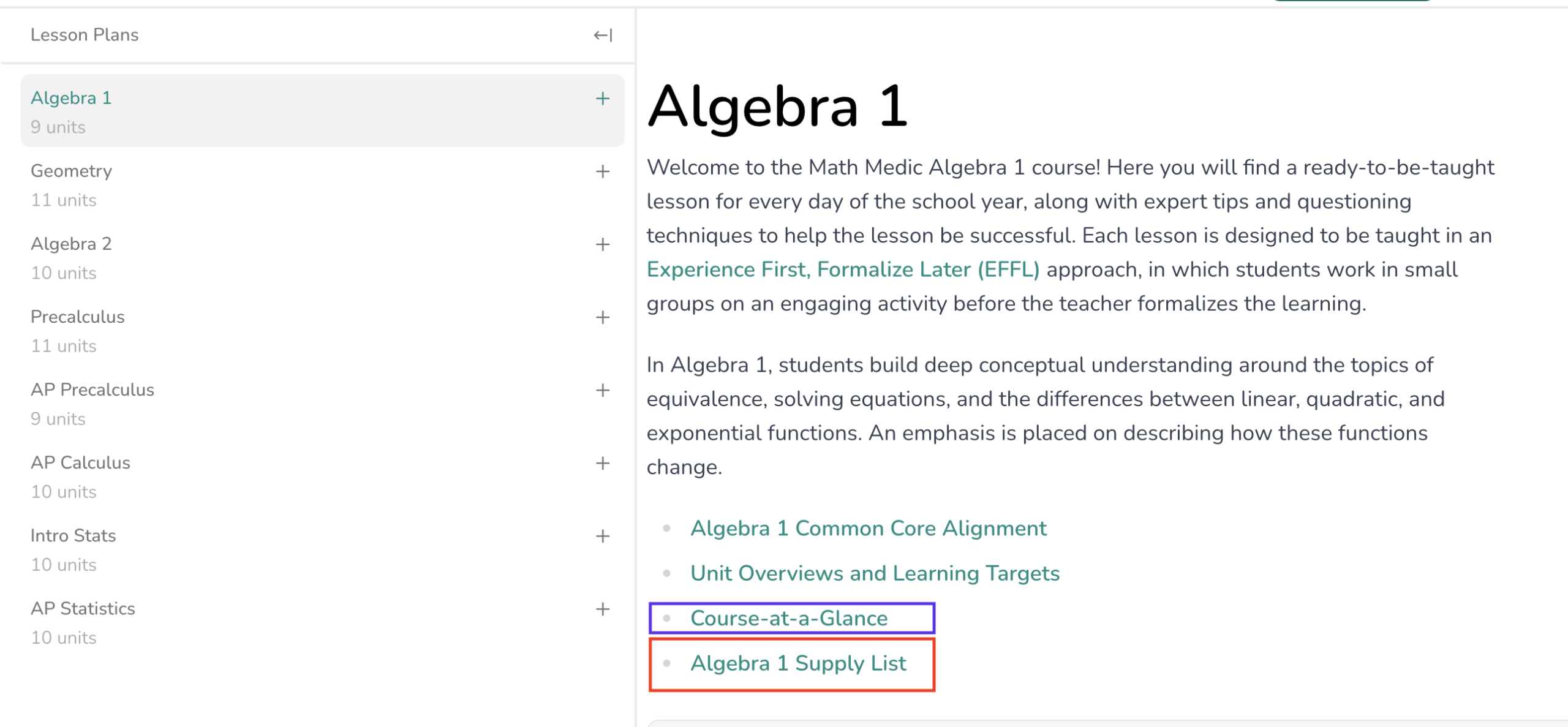
Did you know that each of our Math Medic courses comes with a supply list? We’ve gone through every single EFFL lesson of the course and identified the materials you’ll need for each lesson and compiled them on one sheet. They’re organized by unit, so you can get supplies as you need them for each unit or you can do one big Amazon order now! Supply lists (and other helpful resources) are located on the landing page for each course, so be sure to hop over there before looking at the lesson plans in more detail.
2. Course-at-a-glance documents
Want to know how many days are in each unit and how our units break down in terms of lessons, review days, and assessment days? We’ve got you covered! Our course-at-a-glance documents are 1 page summaries of each course, so you know exactly how to schedule your year if you’re going all-in with Math Medic resources, or can make plans to modify the schedule if your school follows an alternative schedule. These are also found on the course landing page in the lesson plans tab of the teacher portal.
A Pep Talk for the Start of a New School Year
As you head into this school year, remember that the first week is not about creating a perfectly polished classroom or having every routine mastered by Friday. It’s about beginning the process of building relationships, establishing a classroom where students feel valued, and creating the foundation for the mathematical thinking you want to see all year long. Some things will go exactly as planned. Some things will not. And that’s okay. A routine can be retaught. A lesson can be adjusted. The first day is only one day, the first week is only one week, and there are hundreds of opportunities ahead to build the classroom you envision. The most important thing you can bring to the first week is not a flawless plan—it’s the belief that your students belong in your classroom and that this year is full of possibilities. Cheers to a new school year!
About the Author

Sarah Stecher
Sarah is our “content creator” in every sense of the term. In addition to designing lessons, Sarah writes blog posts, develops resources, and leads Math Medic workshops for schools and districts. She’s also our go-to for AP Calc and Precalc questions from teachers, since that’s what she was teaching before she joined the team. Along with Lindsey and Luke, Sarah was a high school teacher who taught 150+ students every year at East Kentwood High School.