
Cross Country Traveling
Sarah Stecher
As you’re starting a new school year and trying to establish classroom routines, one thing is obvious: the kind of classroom we want doesn’t happen automatically. We want students to share unfinished ideas, listen closely to one another, ask questions, disagree productively, and work together when the answer isn’t immediately obvious. Those habits take time to develop—and they’re worth teaching intentionally.
So at the beginning of the year, we teach students how to learn together in much the same way we teach mathematics: Experience First, Formalize Later. Rather than starting with a list of expectations for groupwork, we give students an experience that helps them discover why those expectations matter.
Our norm-building activities are designed to do exactly that. Each task creates opportunities for students to experience particular group dynamics firsthand. What happens when everyone contributes? Why does it matter to listen to someone else’s thinking? What makes a group effective when they get stuck? After the activity, we name and formalize the habits students just experienced to form classroom norms we can return to throughout the year.
One of our favorite ways to start building those classroom norms is with a task that has plenty to think about, but doesn’t require any particular math content to get started. Enter: Cross Country Traveling.
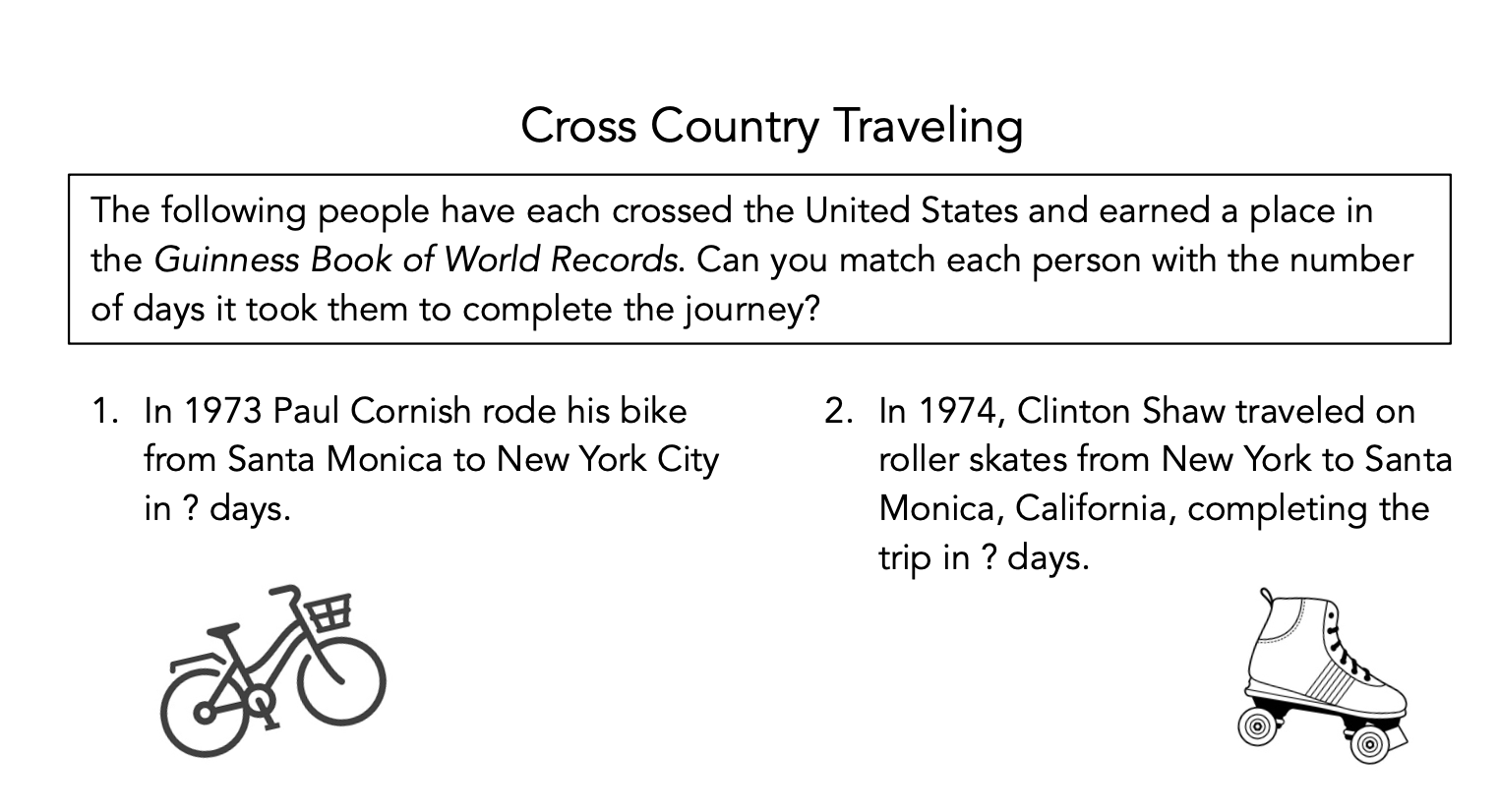
The Activity
In this activity, students match six Guiness Book of World Record entries for crossing the U.S. to the times that it took each person to complete their journey (13.22 days, 18 days, 53.51 days, 62 days, 127 days, 384 days). They work in groups to share their thinking and provide viable arguments to support their claims. Here’s what you can expect to see:
- Students coming up with convincing arguments (“But the car was driving in 1929! The roads would have been terrible!”)
- Students revising their thinking after hearing the claim and evidence presented by one of their groupmates (“Ohhhh, yeah I didn’t consider that before!”)
- Students bringing their unique experiences to shed light on the scenarios (“I was on crutches last year and it’s almost impossible to go more than a few minutes without resting! I think the crutches would have taken longer.”)
Why is this valuable? Because these ways of sharing ideas, providing evidence, and revising one’s thinking are critical to a productive math environment. They are directly aligned to the following classroom norms that many of us strive for:
- Give reasons for your claims.
- Be willing to revise your thinking.
- Everyone brings valuable ideas to the table.
- Speak up when you don’t agree.
- Listen for good arguments, not just to whoever is the loudest.
Debriefing the Activity
As you are walking around while students are working in groups, keep track of little snippets of conversation that highlight these norms. Then when you are debriefing the activity, say things like “Anita, I heard you share what you knew about the difference between roller blades and roller skates. How did that help your group?” or “In this group, I heard Pedro make an observation about paying attention to the year in which these voyages occurred. That was an important contribution to the group!” or “Who would be willing to restate a really convincing argument that somebody else in your group made? What made it convincing?”
I always end the debrief of Cross Country Traveling with these two questions
- “Who changed their mind based on what someone else in their group said?” (Wait for show of hands.)
- “Why do you think that is important in a math class?”
Solutions
If you’ve read through the prompts in this activity and are itching to know what the right answers are, congrats! You’re just like every math teacher out there! But before we give them to you (and we will), we want to make a convincing argument for not providing them to your students at the end of this activity.
Something that can be frustrating for students is when things aren’t wrapped up in a nice neat bow. Cognitive dissonance or non-resolution can be challenging for students (and adults!) to endure, but we believe there is true value in this experience, as it often leads to more learning. When we facilitate this activity in our own classrooms, we purposefully don’t provide the solutions and instead use this opportunity to talk about another one of our math norms: accept non-closure. How does it feel when we don’t get the resolution we want? What can we do when we’re feeling that way? Is it okay if things feel unfinished? Having this conversation is a really important part of fostering productive struggle, and helps students understand that 57-minute class periods aren’t always the perfect conduit for beginning-to-end learning. Some things just take time!
And for those of you who are practicing the norm of speaking up when you disagree, here are the solutions:
- a
- d
- c
- b
- f
- e
About the Author

Sarah Stecher
Sarah is our “content creator” in every sense of the term. In addition to designing lessons, Sarah writes blog posts, develops resources, and leads Math Medic workshops for schools and districts. She’s also our go-to for AP Calc and Precalc questions from teachers, since that’s what she was teaching before she joined the team. Along with Lindsey and Luke, Sarah was a high school teacher who taught 150+ students every year at East Kentwood High School.