
What Kind of Mathematics Invites Student Thinking?
Sarah Stecher
This blog is the first in a series on teaching for mathematical thinking. Before we discuss the class environment, teaching moves, assessment practices, and content knowledge for teaching, we have to go back one step further. What kind of mathematics do we value? What do we want students doing during math class?
I may sound like a broken record at this point, but I’ll say it again anyway: if we want students to engage in mathematical thinking, we have to give them something to think about. Sometimes what we say we want students to be doing in the classroom (discussing, reasoning, making sense) and what we actually have them do (take notes, learn procedures, do practice problems) don’t align. Expecting a rich discussion around a problem with a prescribed solution path is like expecting a good night’s sleep when you drink coffee at 10 pm. Not impossible, but highly unlikely.
Task selection is of course not everything when it comes to good teaching, but it is a critical element of creating the environment where deep thinking and learning can happen. In Peg Smith and Mary Kay Stein’s book “5 Practices for Orchestrating Productive Mathematics Discussions”, they identify “Setting Goals and Selecting Tasks” as Practice 0, i.e. the foundation for rich mathematical discourse.
If we want rich conversations, we need rich tasks. Rich tasks are tasks that create opportunities for multiple strategies, meaningful discussion, and deeper understanding of important mathematical ideas. So what makes a task “rich”?
Features of Rich Tasks
- Low floor: everybody has an access point into the task. The prompt is inviting and straight-forward enough to spark initial ideas, even if those ideas don’t lead immediately to a solution path. There are multiple entry points into the problem so students have various options for how to get started, depending on what they find intuitive or what makes sense to them.
- High ceiling: there is open-ended depth. Extensions arise naturally from students’ curiosity about the task. “What would happen if…?” “Will this always be true?” “Under what conditions would…” “Is there a more efficient way?” “Can I come up with another way to represent my thinking?”
- Multiple solution paths: more than one strategy exists for coming up with the right answer. A rich debrief comes from comparing and connecting different strategies in ways that mutually reinforce the conceptual idea of the lesson! Students learn new ways of thinking and reasoning by first understanding, and then applying, a strategy proposed by one of their peers.
- The mathematics is not prescribed: students have agency about which strategies and representations they will use to make sense of the problem. Asking students to solve one particular problem in one particular way does not provide many ideas for teachers to notice, discuss, and build upon.
- Justification matters: having an answer is not enough. Students need to provide convincing arguments at various levels of formality about why their solution works. Rather than relying on the teacher to say whether an answer is right or wrong, students learn to use mathematical arguments to convince themselves.
- Student thinking is visible: a teacher gains information about how a student is reasoning, what relationships they are using, and what makes sense to them. Student thinking is made visible through written work on their papers or on whiteboards and through conversations with students while monitoring or debriefing the task. Without this information, teachers cannot build the bridge between what students currently understand and what we set out for them to learn in the lesson.
A rich task does not simply mean “difficult” or “complex”. Nor does it necessarily need to be “real-world”, though many real-world tasks naturally offer the complexity and ambiguity that allows for multiple viewpoints and strategies. Tasks are rich because of the kind of thinking they invite.
Examples of Rich Tasks
We’ll now look at two examples of rich tasks. These tasks were used with rising 9th graders at our 2026 Summer Teacher Lab. The participating students had not yet taken Algebra 1.
Example 1: The Candle Problem
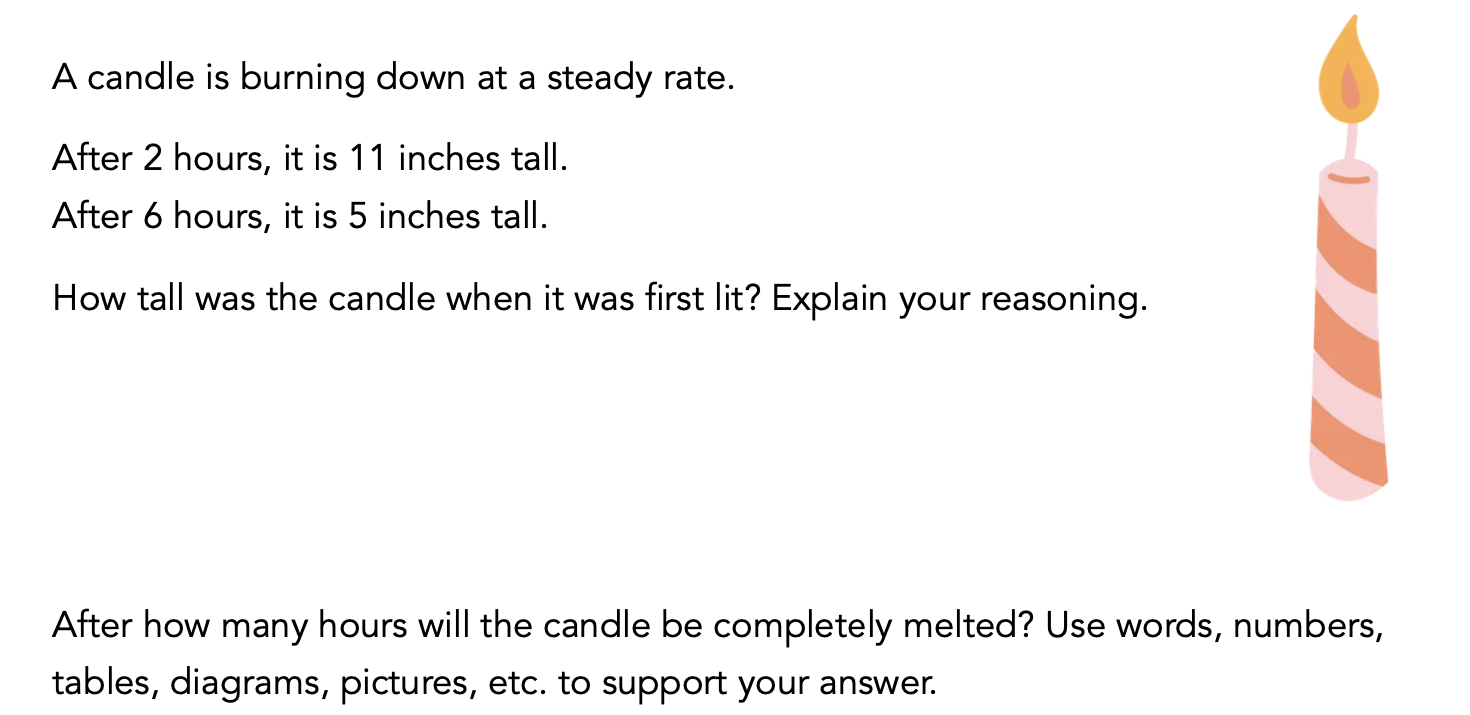
Why this problem is rich:
- The problem is clearly stated and easy to understand. The context of this problem allows students to check the reasonableness of their answers. For example, they know the candle must have been taller than 11 inches to start.
- There are many ways students can solve this problem. Some might find a unit rate of how many inches the candle burns down each hour. Some might think in chunks of two hours. Some might think of this graphically as a line where the horizontal axis is time and the vertical axis is height of the candle and then find the y-intercept. Some students might use a table.
- Students are asked to justify their answer, not just come up with a correct answer.
- Students are not prescribed to write the equation of a line first. Some students might use this method but it is not elevated as the “preferred” method.
- Students reason about key conceptual ideas of linear (and functional) relationships: a constant rate of change, two covarying quantities, lines, slope, rates, chunking, scaling, reiterating, etc.
Example 2: The Pizza and Soda Problem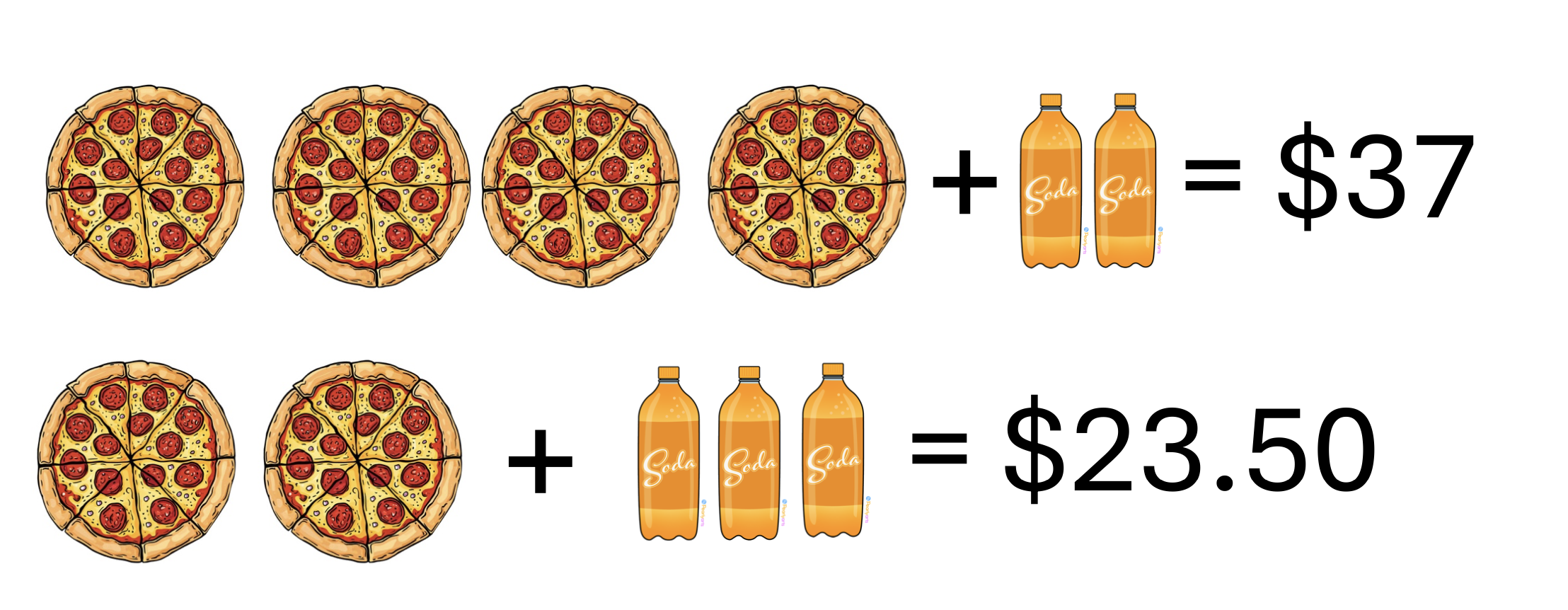
We provide these two purchases and ask students to determine the price of a pizza and the price of a soda before they have ever seen a system or the strategy of elimination. Challenging? Yes. Doable? Yes! Empowering? Double yes!
Why this problem is rich:
- The problem is stated in a simple way; in fact, no words are given at all. Because there are no barriers to understanding the task, every student can get started. Most students started by guessing the price of a pizza and figuring out what soda would have to cost in order to make the first purchase sum to $37. Now getting the second purchase to also be $23.50 was another problem…
- The problem requires collaboration as it is too challenging to do alone. We would call this task a “group-worthy” task.
- Students can use their intuition about how these purchases are related and what they can deduct from that information, rather than using a procedure they had (not) been taught.
If you’re starting to think that these rich tasks are not quite so intimidating, you are correct! Rich tasks are designed to promote rich thinking, and rich thinking happens primarily when we give students a problem that they do not know how to solve with a formal procedure or strategy.
Why Use Rich Tasks
We talk a lot around here about what it actually means to do mathematics. The use of rich tasks is built on a simple premise: math class is about thinking and reasoning, not just answer-getting. We believe that mathematics is a lot broader than what is traditionally emphasized in high school math classes: speed, memorization, and executing procedures. Math is about problem solving, reasoning, making conjectures, critiquing arguments, justifying thinking, listening and responding to the ideas of others, representing one’s thinking, and being able to use structure to understand and solve problems. These are the mathematical practices! As you look back at the two example tasks and at your own curriculum, consider these questions: What does this task communicate about what it means to do mathematics? What kind of thinking does it invite? When we continue this series, we’ll discuss what kind of classroom environment makes that thinking possible.
About the Author

Sarah Stecher
Sarah is our “content creator” in every sense of the term. In addition to designing lessons, Sarah writes blog posts, develops resources, and leads Math Medic workshops for schools and districts. She’s also our go-to for AP Calc and Precalc questions from teachers, since that’s what she was teaching before she joined the team. Along with Lindsey and Luke, Sarah was a high school teacher who taught 150+ students every year at East Kentwood High School.