
Best Friends Forever: Two-Way Tables and Venn Diagrams
Math Medic
Two-Way Table

Two-way tables provide a clear and concise method for organizing probabilities for two events. I have discovered that students develop deeper understanding of two-way tables if I have them create one from a scenario, rather than putting a completed one in front of them and then asking a bunch of questions.
Scenario: 80% of students at East Kentwood High School have an Instagram account. 60% have a Twitter account and 45% have both Instagram and Twitter. Fill in the table:
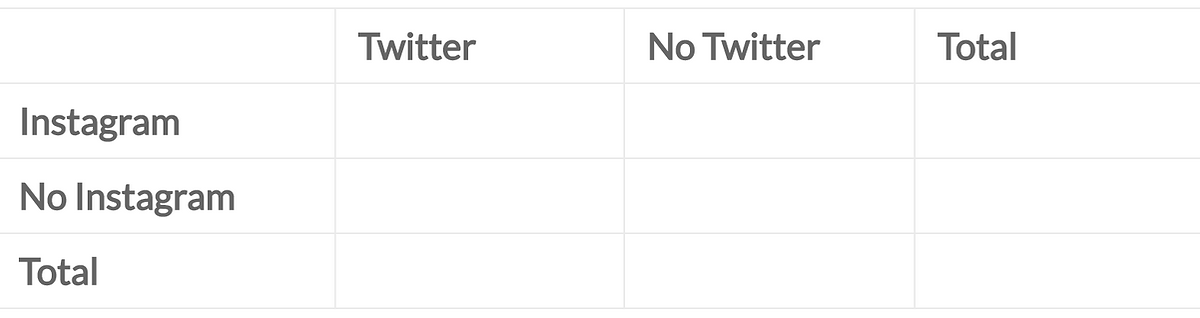
Most often students will correctly start with the 45% who have both Instagram and Twitter. The struggle is where to put the 80%. With some thinking they realize that the 80% includes both Instagrammers with Twitter and Instagrammers without Twitter. The 80% belongs in the Total column for Instagram. This realization will make them less likely to make the 4-hour detention mistake in the Venn Diagram (see below).
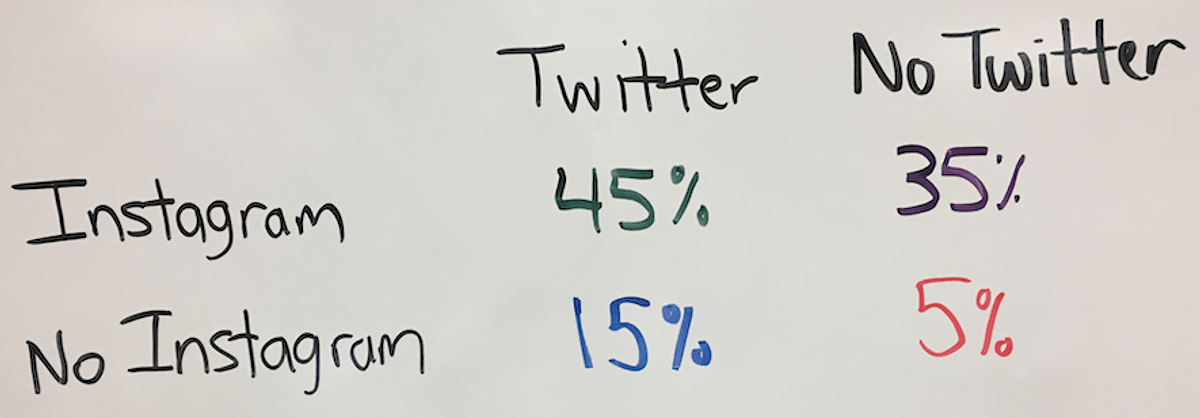
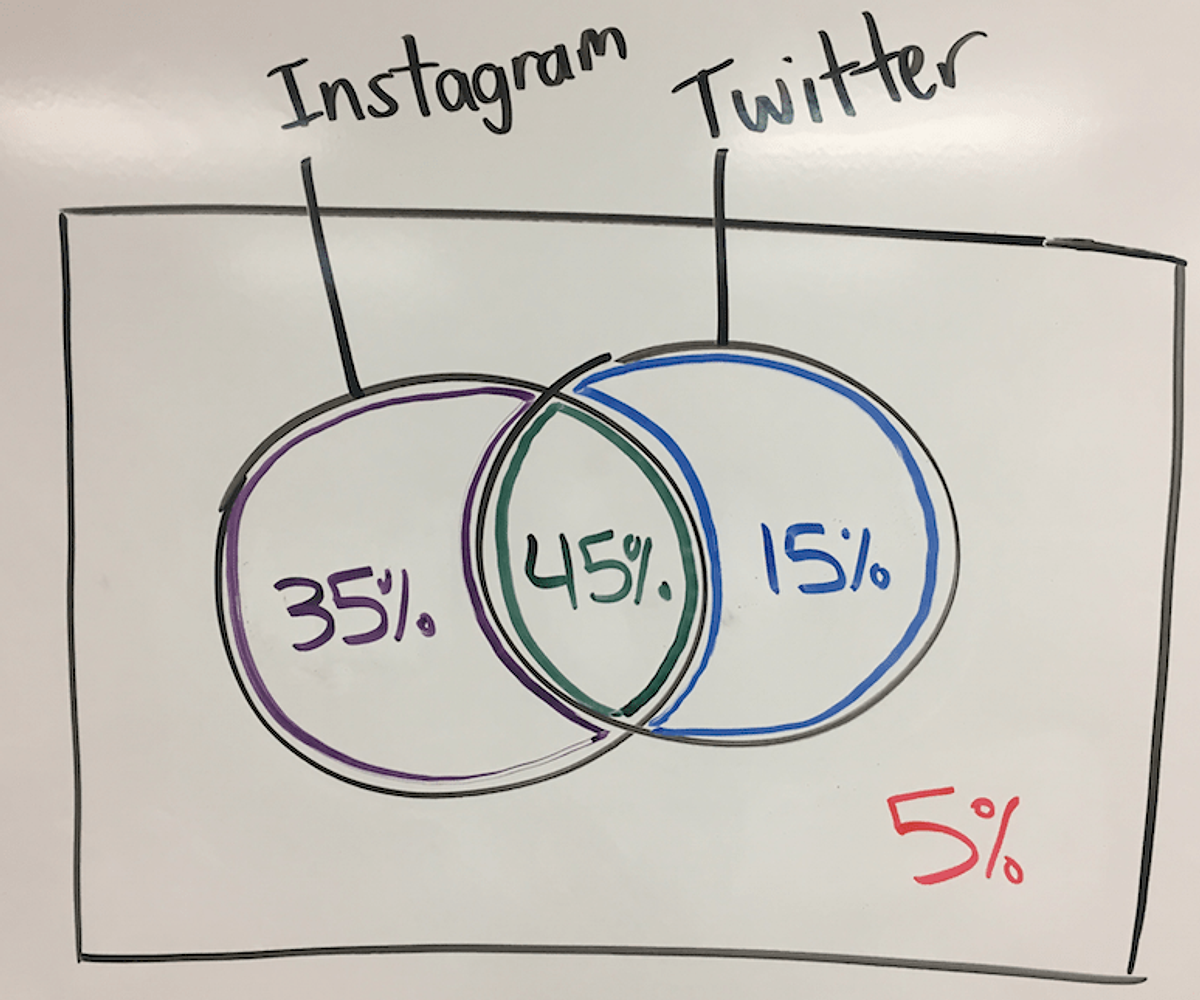
Venn DiagramUsing the same Instagram, Twitter context from above, I have students create a Venn Diagram. I am sure to point out that the Venn Diagram has 4 different spaces, which correspond to the 4 values in the two-way table (not including the totals).
Space #1 – The left pacman. Instagram and no Twitter. 35%
Space #2 – The center football. Instagram and Twitter. 45%.
Space #3 – The right pacman. No Instagram and Twitter. 15%.
Space #4 – The outside. No Instagram and no Twitter. 5%.
4-hour detention
The most common student error on the Venn Diagram is to put 80% in the left pacman and 60% in the right pacman. An immediate red flag for this decision is that now the sum of the probabilities is well over 100%. Hopefully by having to construct the two-way table first, they will be less likely to make this mistake. I model this mistake in front of the class several times, each time waiting for students to call me out. If students make this mistake on a quiz or a test, they are asked to serve a 4-hour detention with me after school.