
NCTM 2026 Recap – Start With What Makes Sense
Sarah Stecher
On Friday I had the chance to present at the NCTM Annual Meeting in Denver. The session was titled Start With What Makes Sense, and it was built around a simple argument: students gain access to rich mathematical ideas by being given opportunities to reason through scenarios that make sense to them, that they find intuitive, and that answer real mathematical questions.
We looked at three bread-and-butter math topics: solving equations, writing the equation of a circle, and finding an angle in a right triangle. For each one, we started with the advice we’ve all heard (and probably given) and then asked a different question: What is the actual mathematical question here, and how can students make sense of it?
This is a companion post to an earlier post we shared, Start With What Makes Sense. That post introduced the big idea and my NCTM session unpacked the idea and what it looks like across three different topics.
The Traditional Advice
Let’s start with solving equations. Here’s the kind of advice you’ll find in a lot of textbooks and notes.

These suggestions have a panic-y nature to them, don’t they? Warning! Don’t forget! Remember! Watch out! Do the same thing! Do the opposite! I can feel my heart rate going up just reading it. This kind of advice positions math as something almost dangerous that should be approached with the utmost caution. Not exactly welcoming for a learner.
I consider this a geographical approach to teaching equations. Everything is about where the terms are and where they should end up. Move this to the left side. Move that to the right side. Get x by itself.
That last phrase has always confused me. I remember so vividly sitting when I first heard my teacher say “get x by itself” and I had no idea what that meant, and what it had to do with solving equations. And I also remember vividly the day I used that exact same phrase with my own Geometry students, as I tried to “help” them solve linear pair and vertical angle equations.
So why do we reach for this kind of advice? Why, even when I myself found this advice confusing, did I use it with my own students? Here are a few thoughts:
- We want students to get to the right answer.
- We feel crunched for time.
- We don’t feel like we understand the underlying mathematics well enough to explain it differently.
- That’s how we were taught.
None of those reasons make us bad teachers. They make us human. But the same pattern shows up all over the curriculum. Circles? Just flip the sign! Right triangle trig? Label, choose, calculate. Here are the other two pieces of advice we looked at.


What does this kind of advice help students do? Is it truly helpful or just expedient?
I’m going to propose an idea that might be unpopular: maybe kids are confused because we make it confusing. We hand them rules, tricks, and tips to help them arrive at an answer, but we don’t give them experiences that help them develop an understanding of the actual mathematical ideas. We teach students what steps to follow to arrive at an answer, but we often bypass the real mathematical question that students can and should be reasoning about.
What If We Started With What Makes Sense?
In my session I made the argument that we need to look at our content from a different lens, so for each topic, we explored a different question: What is the actual mathematical question here, and how can students make sense of it?
Solving Equations: What’s the Value of a Fox?
In this lesson, Britney and Hugh are playing a video game where they collect points and foxes. At the end, the foxes get converted into points. Their final scores are tied, and students are asked to figure out what a fox is worth.

Notice what’s missing: there’s no “get x by itself” and no “do the opposite.” Students are reasoning about a situation that makes sense to them. If Britney and Hugh are tied, but Britney has two extra foxes and 10 more points, then those two foxes must wipe out her 10-point lead. The actual question when solving equations is: How is it possible that these two expressions are equal? What has to be true to make them equal?
Circles: Will Pizza Hut Deliver to Your House?
Here, students already know the Pythagorean theorem and the distance formula. Pizza Hut delivers within a 5-mile radius, and students decide who gets pizza and who doesn’t.

Throughout the lesson, students reason with increasing levels of formality about how to prove that Pizza Hut will or will not deliver. They use the coordinate grid to find horizontal and vertical distances and then use the Pythagorean Theorem to calculate the true distance that a customer is away from Pizza Hut. We discuss what it means to be on the Pizza Hut Circle, namely that the customer lives exactly 5 miles away, as one customer did in the activity. Finally, we consider a customer at some ordered pair (x,y) and how we can determine whether they live on the circle or not. We consider their horizontal position from Pizza Hut (x-3) and their vertical distance from Pizza Hut (y-1) and students deduct that if this customer lives on the Pizza Hut circle, it must be true that (x-3)^2 +(y-1)^2=5^2. And that is the equation of a circle, my friends. We are considering various distances from the center and that’s why we see differences (subtraction) in the formula, not because we have to “flip the signs.”
The actual question we are answering with equation of circles is: What does every single point on this circle have in common? Every point is exactly the same distance from the center. Once students see that, the equation of a circle isn’t a pattern of signs to memorize. It’s the Pythagorean Theorem. The traditional approach asks students to remember a pattern of signs instead of connecting the equation to the defining property of a circle. At the risk of sounding like a broken record, let’s start with what makes sense, shall we?
Right Triangle Trig: What’s Your Angle?
Students in this lesson are familiar with sine, cosine, and tangent and have just come off a unit on similarity. They have been using ratios to find missing side lengths but now they will explore how to find a missing angle.
In this activity, students look at three similar triangles and are asked to find either a side length or angle. The debrief drives home the idea that there is only one option for the angle, because the ratio of opposite to hypotenuse in each triangle is one-third. The angle is locked in by the ratio! We discuss that each class of similar right triangles has its own particular DNA that identifies it. Your calculator holds the whole database of which angle goes with which ratio, and the inverse sine, cosine, or tangent button is how you ask it to look one up. The actual question we’re answer with inverse trig is: Only one angle could produce this ratio. Which one?

My new favorite way to teach this is using the analogy of Shazam.
Shazam hears a few seconds of a song and tells you what it is. It doesn’t matter if the song is blasting at a party or playing quietly in a store, because Shazam is matching a fingerprint (the frequency graph of the song, called a spectrogram), not a volume. In trig, the ratio of sides is the fingerprint, the size of the triangle is the volume, inverse sine is the Shazam button, and the title of the song is the angle. And if you want to take this metaphor even further, Spotify does the reverse: you give it the song title and it plays you the song. That’s regular trig!

Try the Lessons Yourself
I’d love for you to experience these the way participants did in Denver. Do the task first, as a student would, and then ask yourself: What is the actual mathematical question here, and how did I make sense of it?
- What’s the Value of a Fox? (solving equations)
- Will Pizza Hut Deliver to Your House? (equation of a circle)
- What’s Your Angle? (inverse trig)
The digital version of the session handout is also available at tinyurl.com/nctm2026medic.
So How Is This Different?
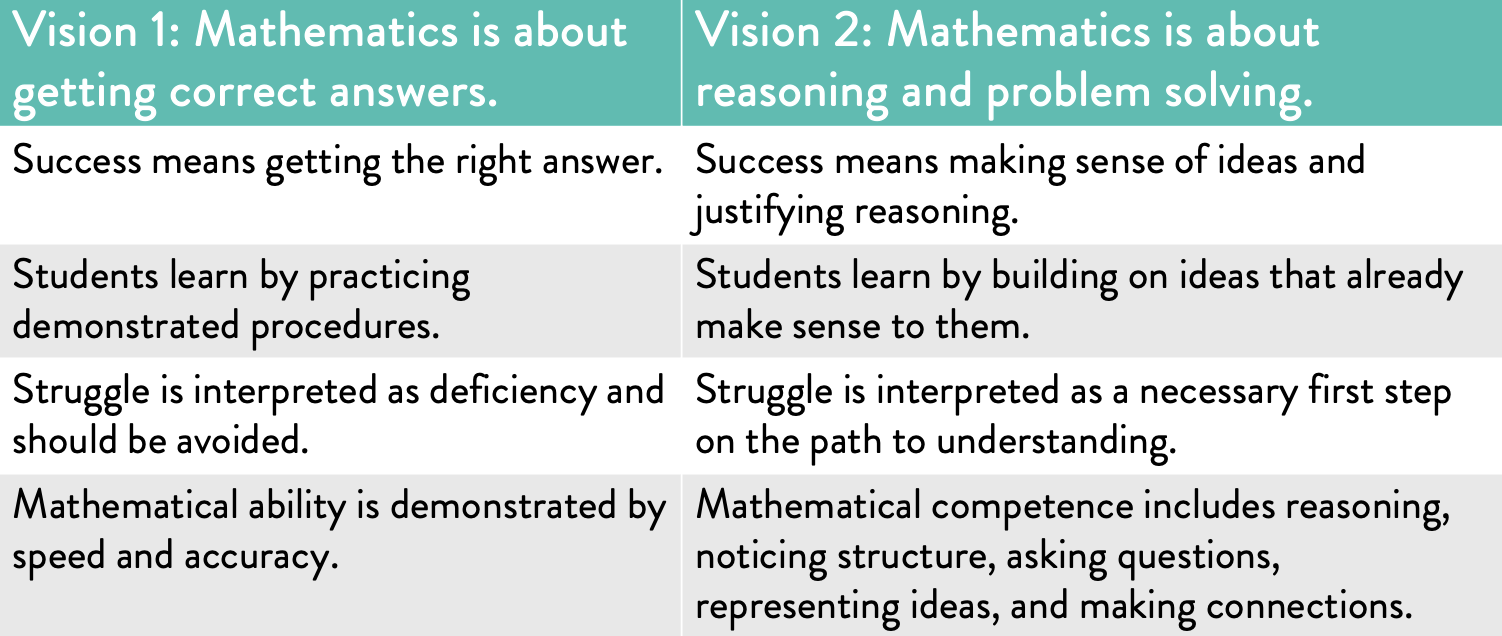
At the end of the session, I asked participants two questions. First: how do these lessons differ from the traditional advice?
The point isn’t simply that the activities were engaging (although I hope they were). It’s that the activities take on a completely different perspective on what it what it means to learn mathematics. Dr. Pamela Seda calls them Vision 1 and Vision 2.
The second question: what might students be able to do if they were given opportunities to investigate real mathematical questions using what made sense to them? This led me to my closing argument.
4 reasons why we should start with what makes sense:
- Better transfer to future math topics. For example, students who understand why equations work can take that thinking to solving non-linear equations.
- A more authentic view of what it means to do mathematics. Mathematicians don’t just follow steps, they reason and problem solve and seek to understand what is happening beneath the surface.
- Deep conceptual understanding saves time in the long run. Students make connections between content and apply overarching principles to new ideas.
- Increased accessibility. It’s no longer just the good memorizers who do well. Every student can use their intuition and experiences to reason about scenarios that make sense to them.
What other topics in your content area need an overhaul? Where can we invite students to use what makes sense to them instead of reaching for the traditional advice?
About the Author

Sarah Stecher
Sarah is our “content creator” in every sense of the term. In addition to designing lessons, Sarah writes blog posts, develops resources, and leads Math Medic workshops for schools and districts. She’s also our go-to for AP Calc and Precalc questions from teachers, since that’s what she was teaching before she joined the team. Along with Lindsey and Luke, Sarah was a high school teacher who taught 150+ students every year at East Kentwood High School.