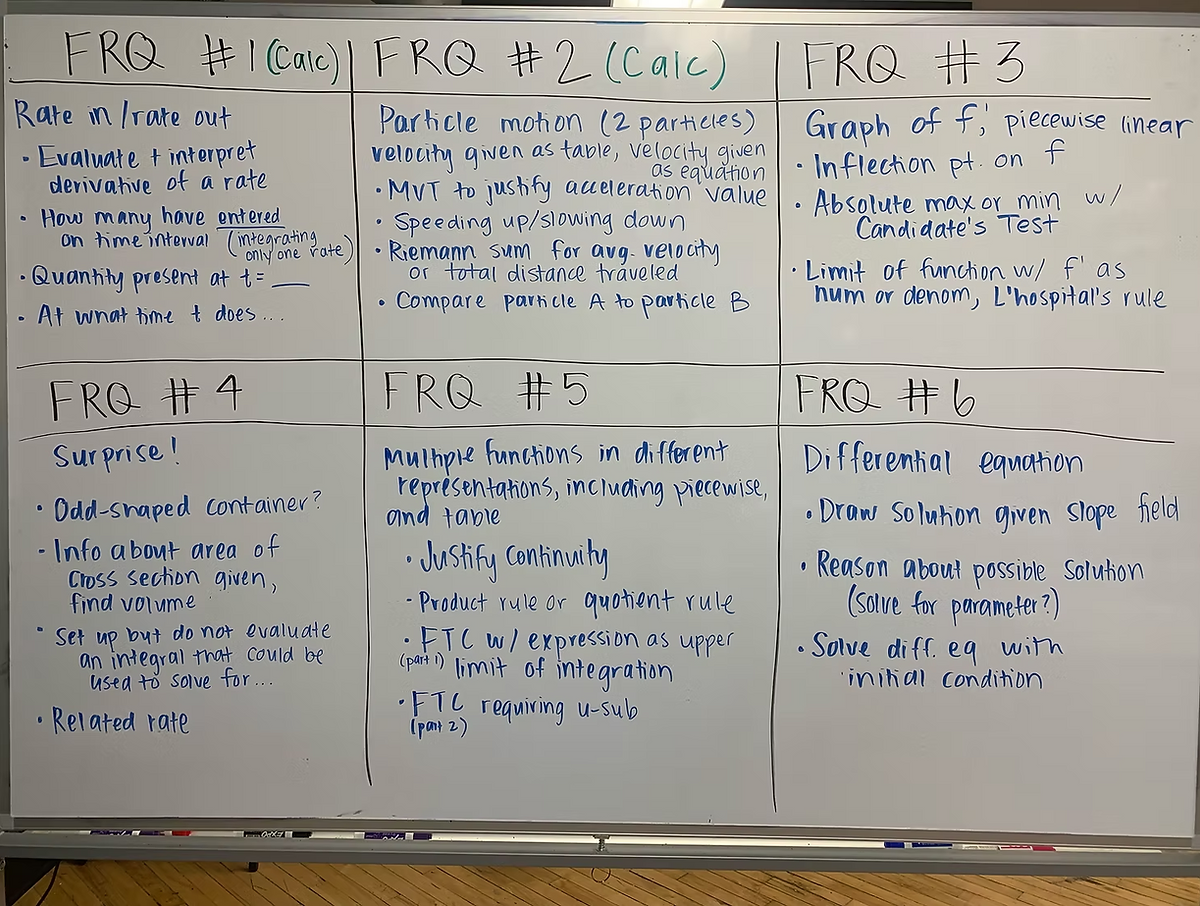
Predictions for the 2026 AP Calculus Exam
Math Medic
There’s something inherently fun about guessing games. Usually our guesses are based on nothing more than a whim, but the satisfaction of having gotten something exactly right, through no real skill of our own? Priceless. (Of course, we like to think of ourselves as logical people who use the scientific method and common sense to generate our conjectures).
Every year we spend some time coming up with our guesses on what will show up on the AP Exam, based on a mix of research, gut instinct, and just a bit of whim. Particularly, we studied the released free response questions from 2021, 2022, 2023, 2024 and 2025 which are the 5 most recent exams written since the release of the new CED. While we know the College Board will always throw us a few curve balls, we’ve seen some very consistent patterns over the last few years (like a contextual differential equation question and the loss of the #classic rate-in, rate-out question, RIP).
This year, we’re sharing predictions for the AB and BC exams. Generally questions 1, 3, and 4 are shared questions between both exams, and questions 2, 5, and 6 are unique to each exam.
If you want to use this as an in-class activity, download the blank AP Exam Prediction template shared later in this post.
Downloads:
Math Medic AP Calculus Exam Predictions Blank
Math Medic AP Calculus Exam Predictions Completed
**DISCLAIMER: We have absolutely no insider information for any of these predictions. Proceed with caution.**
How did we come up with these predictions?
There’s no real way of knowing what will show up on the exam, but below we provide some of our rationale behind our predictions for the 2026 AP Calculus Exam.
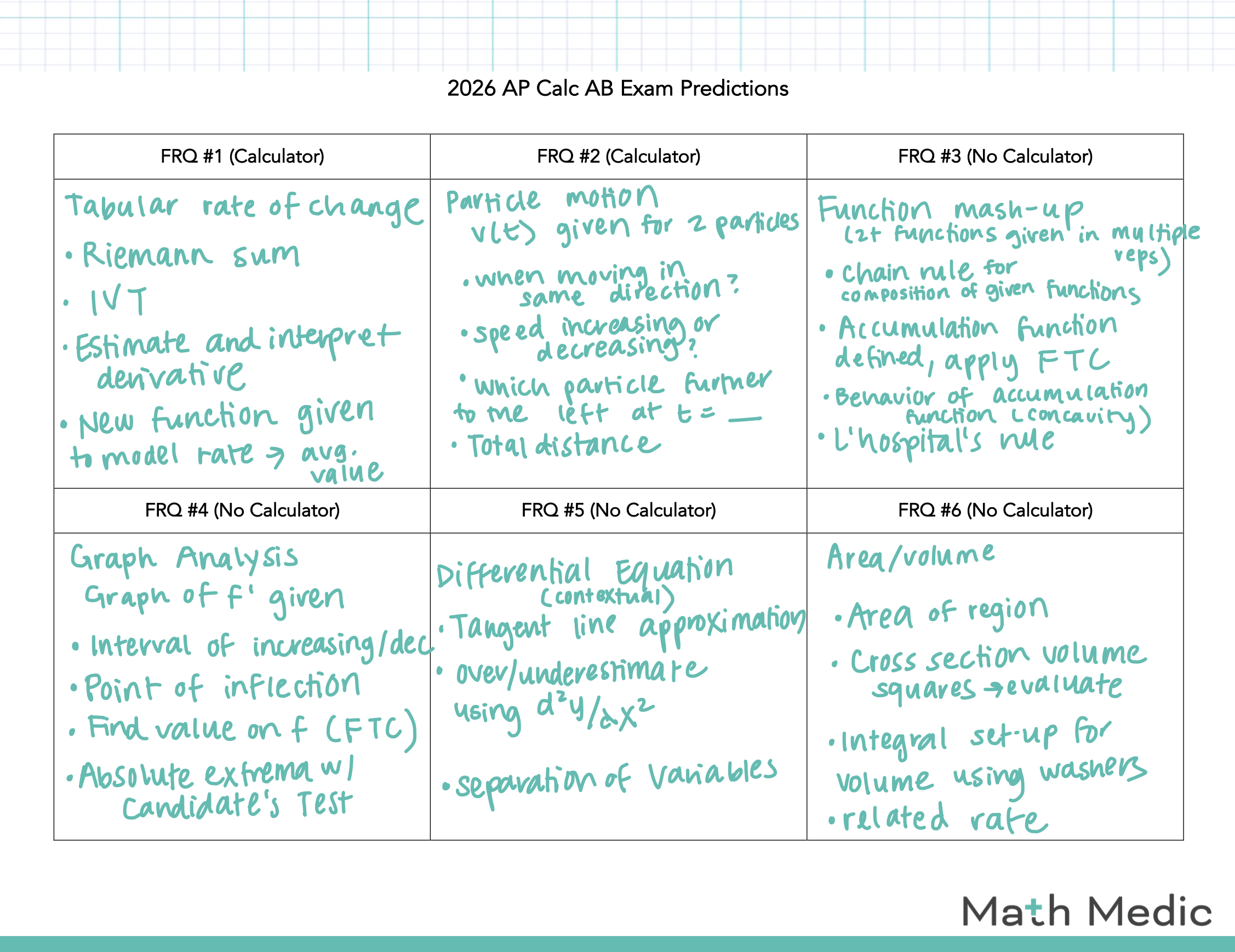
AB
- Tabular rate questions have been spotted several times in FRQ 1, often because students are given calculators to calculate Riemann or trapezoidal sums. Of our two big theorems (IVT and MVT) we think IVT is due since we’ve seen alternating patterns over the last 6 years. Since calculators are available, we think a “complicated” function in analytical form is likely to appear (a rate out, if we’re dreaming big, or just an alternate model for the function presented in the table.)
- Particle motion has been fairly common in FRQ 2, and with the simpler version of the graph analysis question, we think the slightly harder double particle context could be a possibility this year.
- There are only so many things the typical question types can cover, so a function mash-up question can fill the gaps—serving as a catch-all for a whole mix of AP Calc ideas. 2023 AB5 is where we’re pulling our inspiration from.
- The graph analysis question is about as close to a slam dunk as it gets. It comes in two flavors. The graph could represent f’ and the question asks questions about f, or a new accumulation function could be defined with the graph as the integrand function. We think it’s the first one this year. Justifying function behavior and applying the FTC and Candidates test have a strong track record of showing up.
- Differential equations took a break last year (perhaps because of the switch to a digital exam where students could not be asked to sketch a solution curve?) but we think SISIS is on the menu this year. This question could be contextual since there are typically two contextual questions on the AP Calc free response section. Since students can’t draw a solution curve or sketch a slope field, implicit differentiation could make an appearance here, rather than being its own question.
- Area/volume, anyone? Some analytical integration skills could be assessed here when calculating area and volume using cross sections (we would expect a simple shape, like a square), but without a calculator we wouldn’t expect students to evaluate volume with washer questions. Instead, they could be asked to just set up the integral. There has been a related rate subpart in all of the last 5 exams, and we love seeing it connected to area and volume.
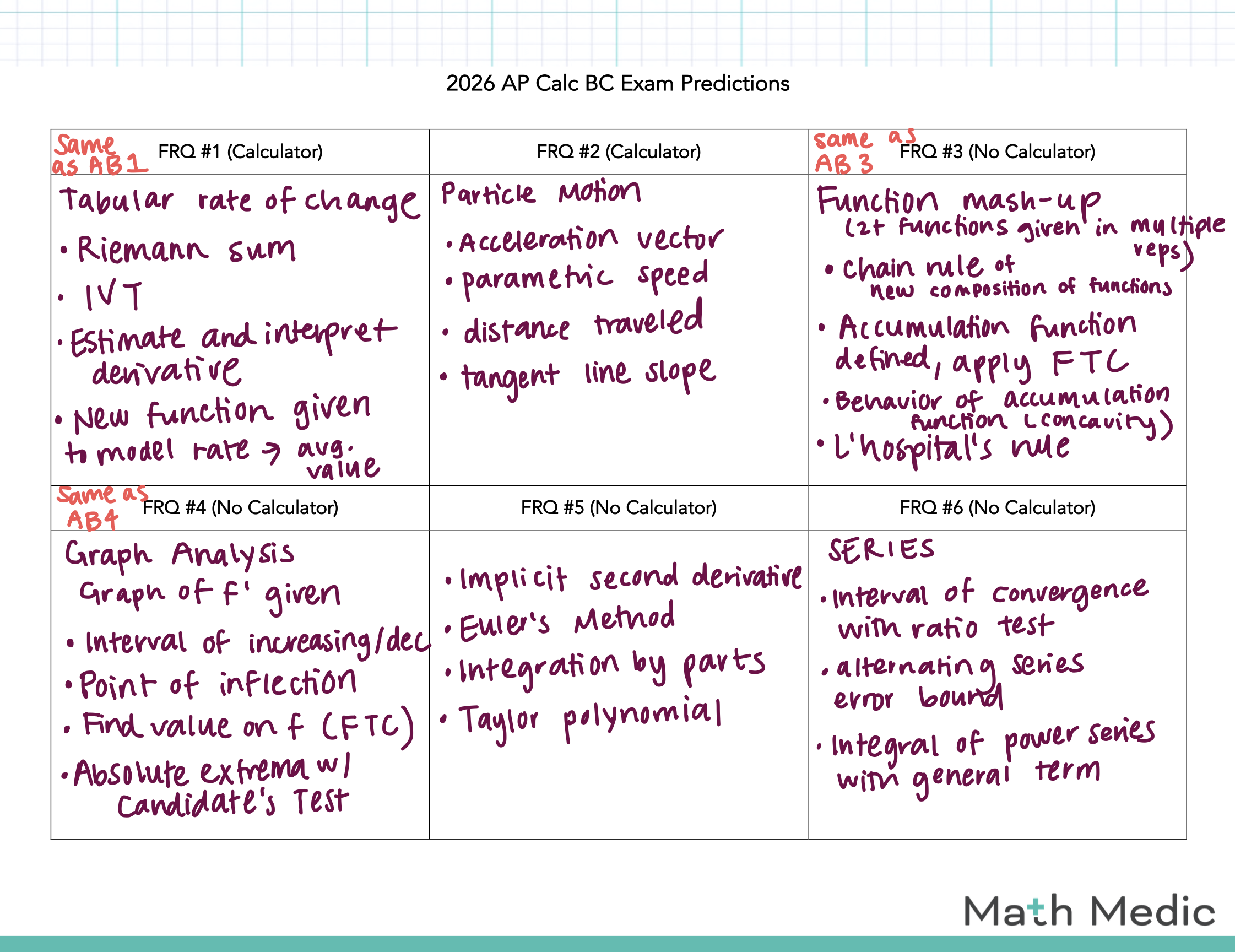
BC
- Parametric/vector motion took a year off in the free response questions last year, but this is still a favorite and will likely make a comeback tour. Applications of derivatives and integrals come easy with position, velocity, and acceleration.
- FRQ 5 varies quite a bit from year to year on the BC exam, but Euler’s method from an equation or table is a frequent guest star. It typically includes one of the advanced integration techniques (parts, partial fractions, improper integrals).
- The last FRQ on the BC exam is the least mysterious of the bunch: it’s always about series. Interval of convergence and one of the error bounds almost always make an appearance. And integrals of power series are fun, so why not? Don’t forget about our series convergence flowchart to help students keep the various tests straight!
Other helpful links
-
Use our FRQ search tool to look up released FRQs from previous years
-
Not sure about some of those FRQ categories we mentioned? Check out our video on the most commonly seen free response questions.
-
Learn about the verbs used on the AP Calc Exam to identify common question prompts and what is required to earn full credit on each.
Looking for last-minute review?
Students, if you are interested in doing some last-minute review for the AP Calc Exam, consider using the Math Medic Review Course. Sign up for immediate access to the entire course, where you can pick and choose to review the topics you need the most help with.
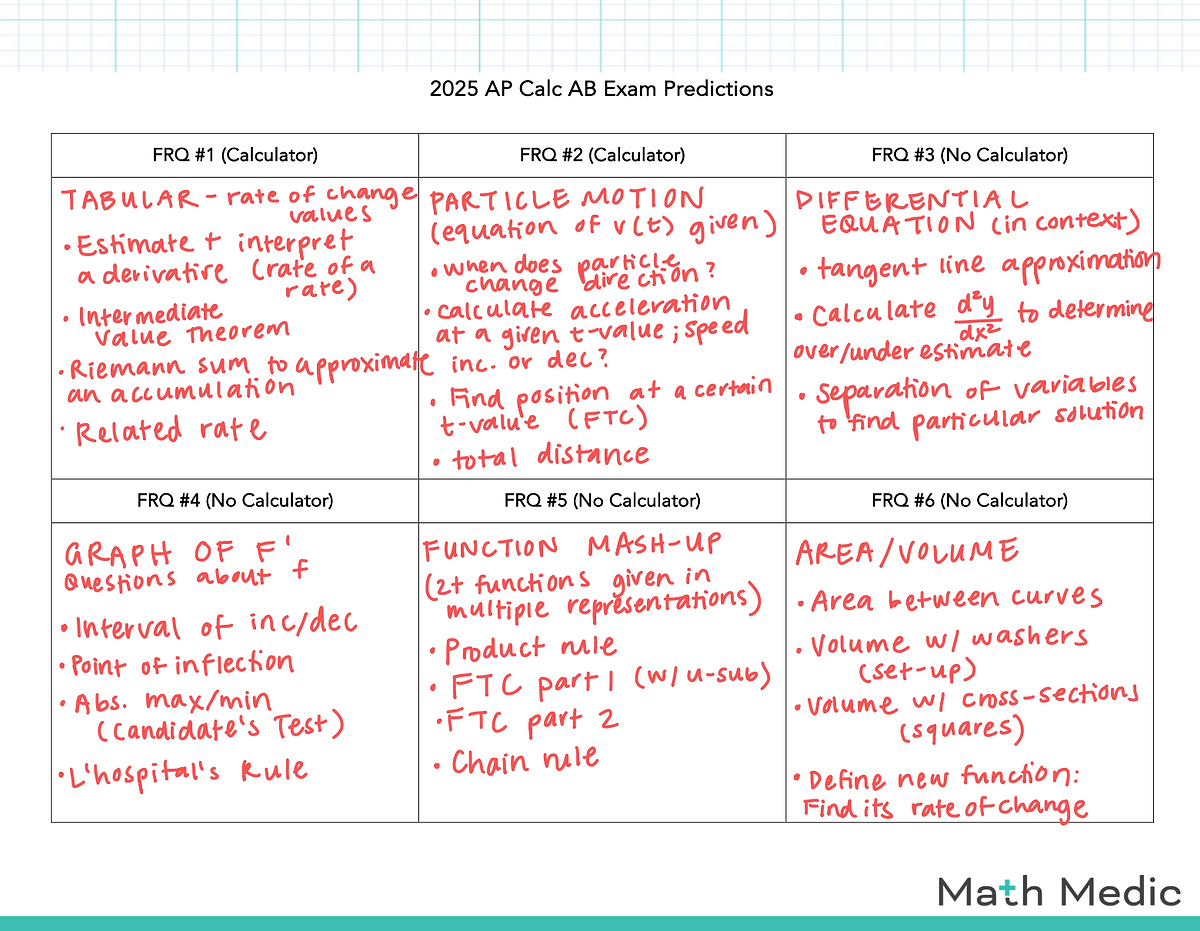
Check out our past AP Exam predictions!
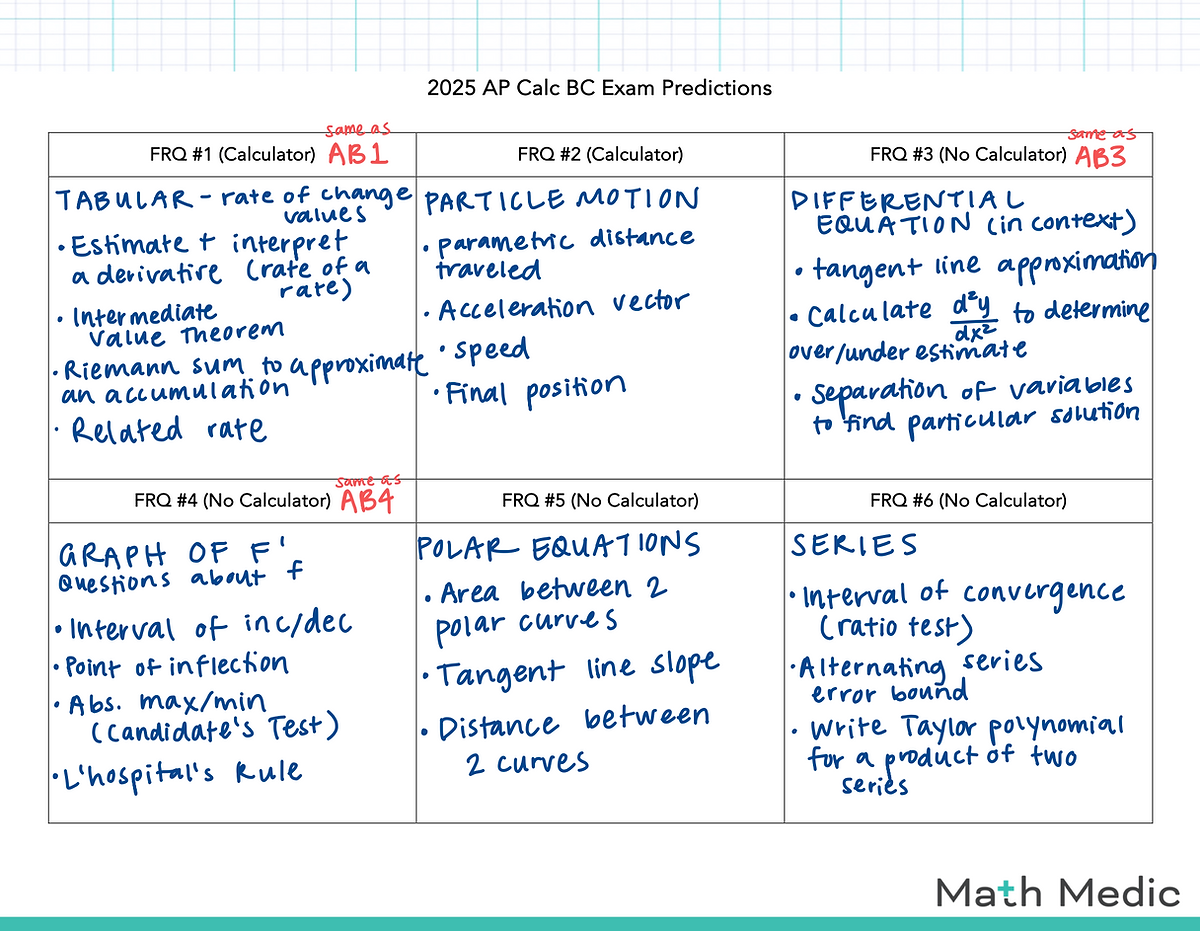
2025
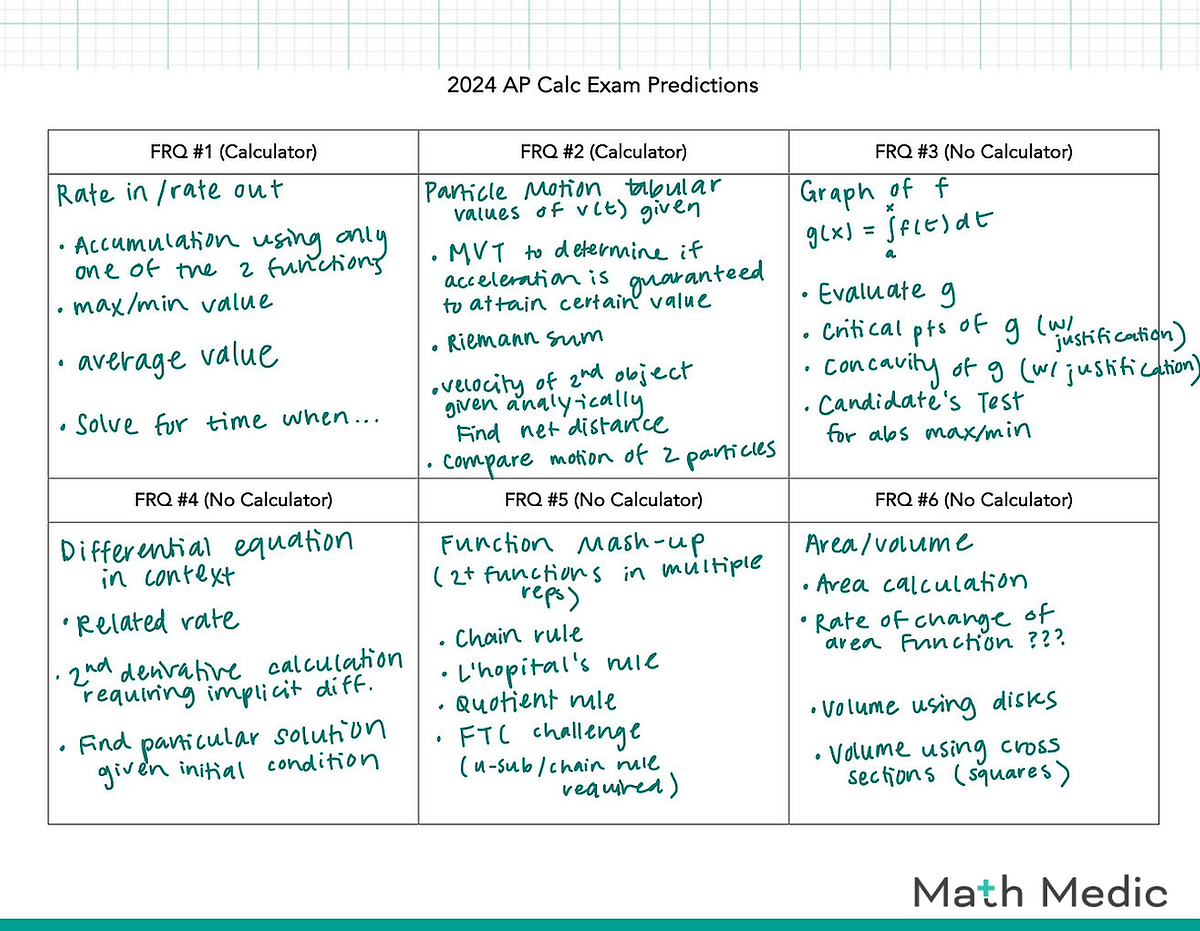
2024
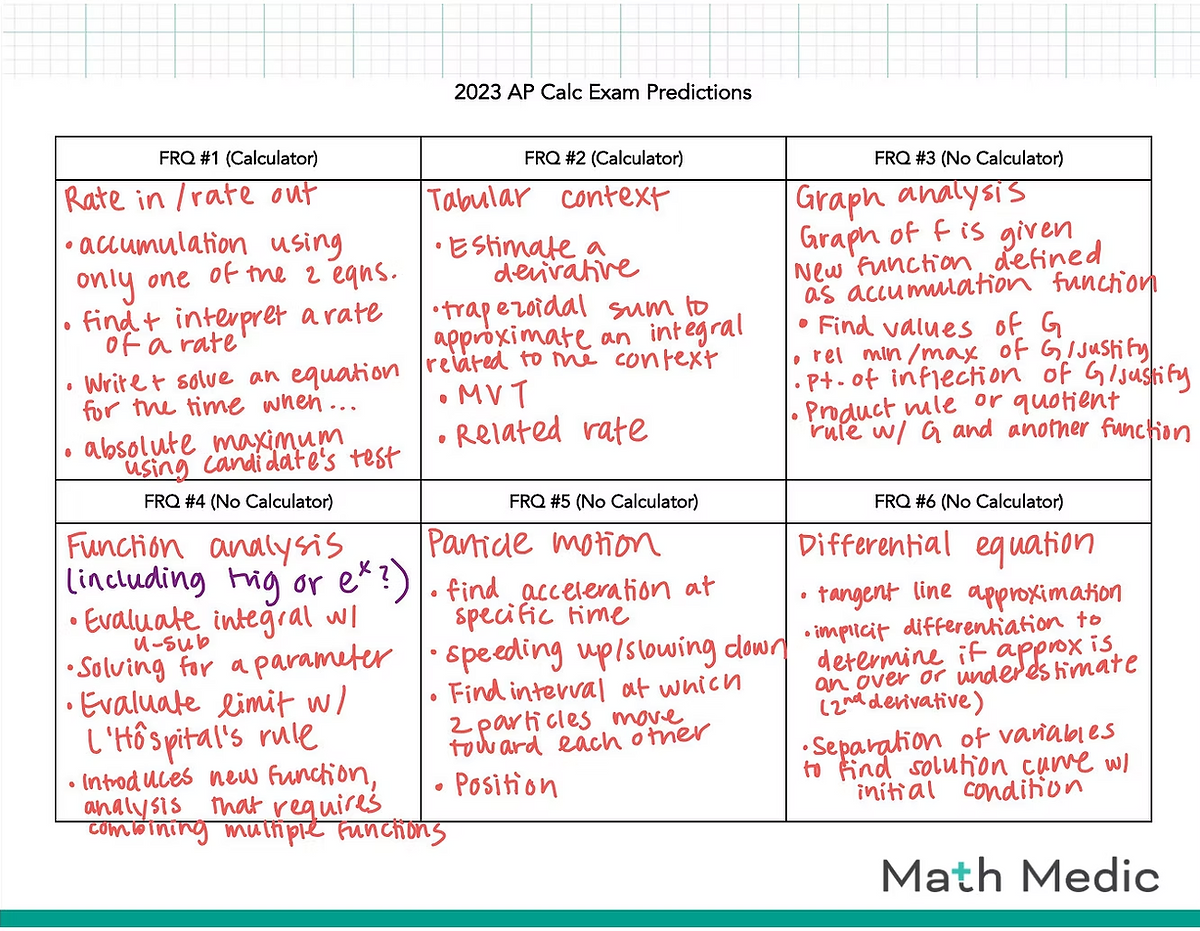
2023
2022