
The 5C Method for Inference
Math Medic
In 2026, the College Board released a revised Course and Exam Description (CED) with some major revisions to the structure of the AP Exam. What didn’t change is that there will be one free response question dedicated to inference (FRQ #3). What did change is that students will now see a set of scaffolded questions instead of a full blank page.
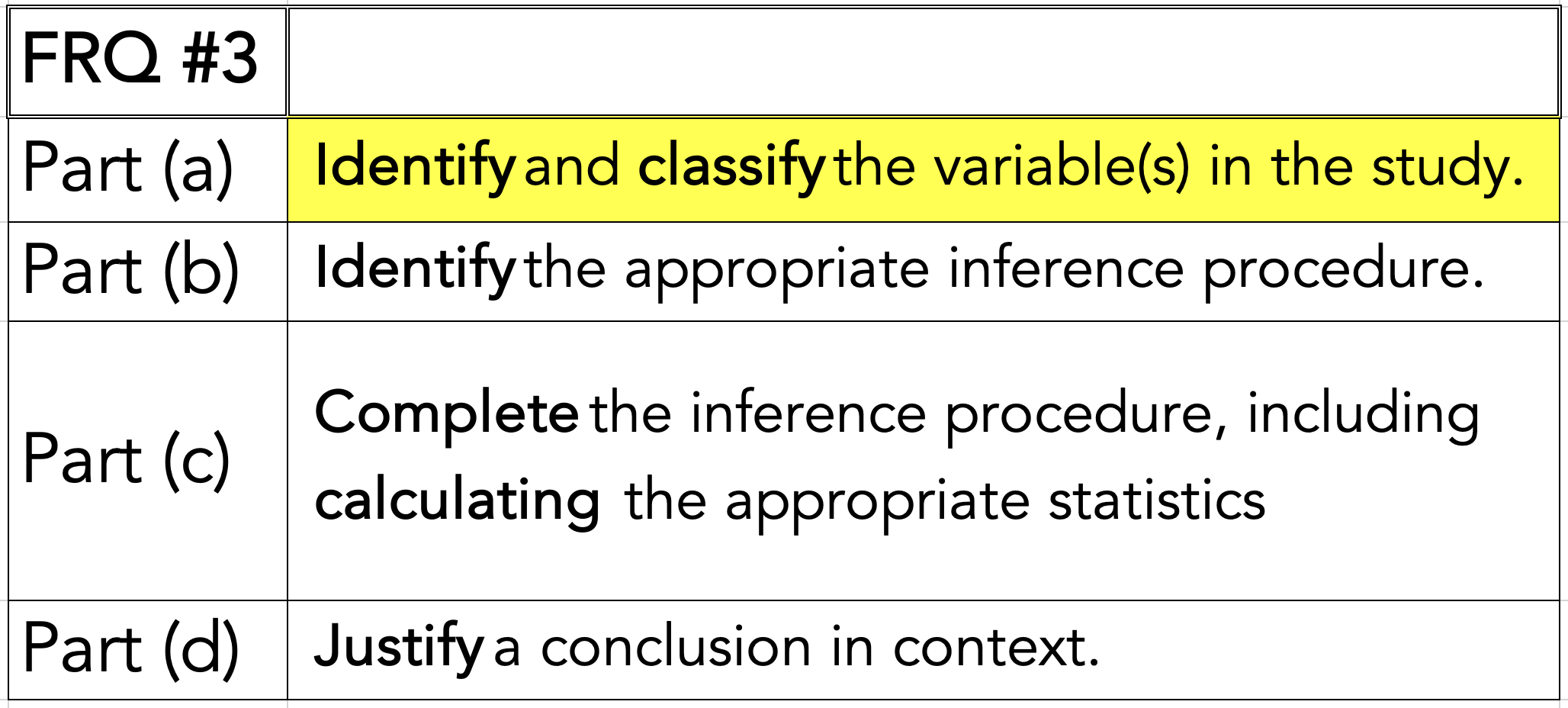
Most of these parts are exactly what we have been doing for inference procedures forever. The glaring new concept being assessed directly at the front of the inference procedure are:

We actually love the idea of students thinking about the variables and type of study to start because it will help students with the remainder of the inference procedure. This has informed our approach that we will use for all of the inference procedures in the new Math Medic AP Statistics curriculum.
The 5C Method for Inference
1. CLASSIFY: Classify the types of variables and type of study.
2. CHOOSE: Choose the inference procedure and set it up.
3. CHECK: Check the appropriate conditions.
4. CALCULATE: Perform the calculations.
5. CONCLUDE: Interpret results in the context of the problem.
CLASSIFY: Get Set Up!
The type of response variable in the study will help students to choose the correct inference procedure (inference for proportions if the variable is categorical, inference for means if the variable is quantitative). The type of study will help students to check the appropriate conditions (observational studies require a random sample and 10% check, experiments require a random assignment check and do not need a 10% check if there are volunteers).

NOTE: This is part (a) of the scaffolded inference question. Here is the rubric:
+1 point
Accurately identifies the relevant information. [Identify variable(s)]
+1 point
Accurately classifies the relevant information. [Classify variable(s)]
CHOOSE: Identify the Inference Procedure
At the end of the course, we want our students to be able to read an AP Exam question and quickly decide what type of inference procedure is needed. Before checking any conditions, before any calculations, and before any conclusions, students must decide what type of confidence interval or hypothesis test is required. This decision ultimately sets up which conditions and formulas will be used later.
This is exactly why we should identify the inference procedure early!
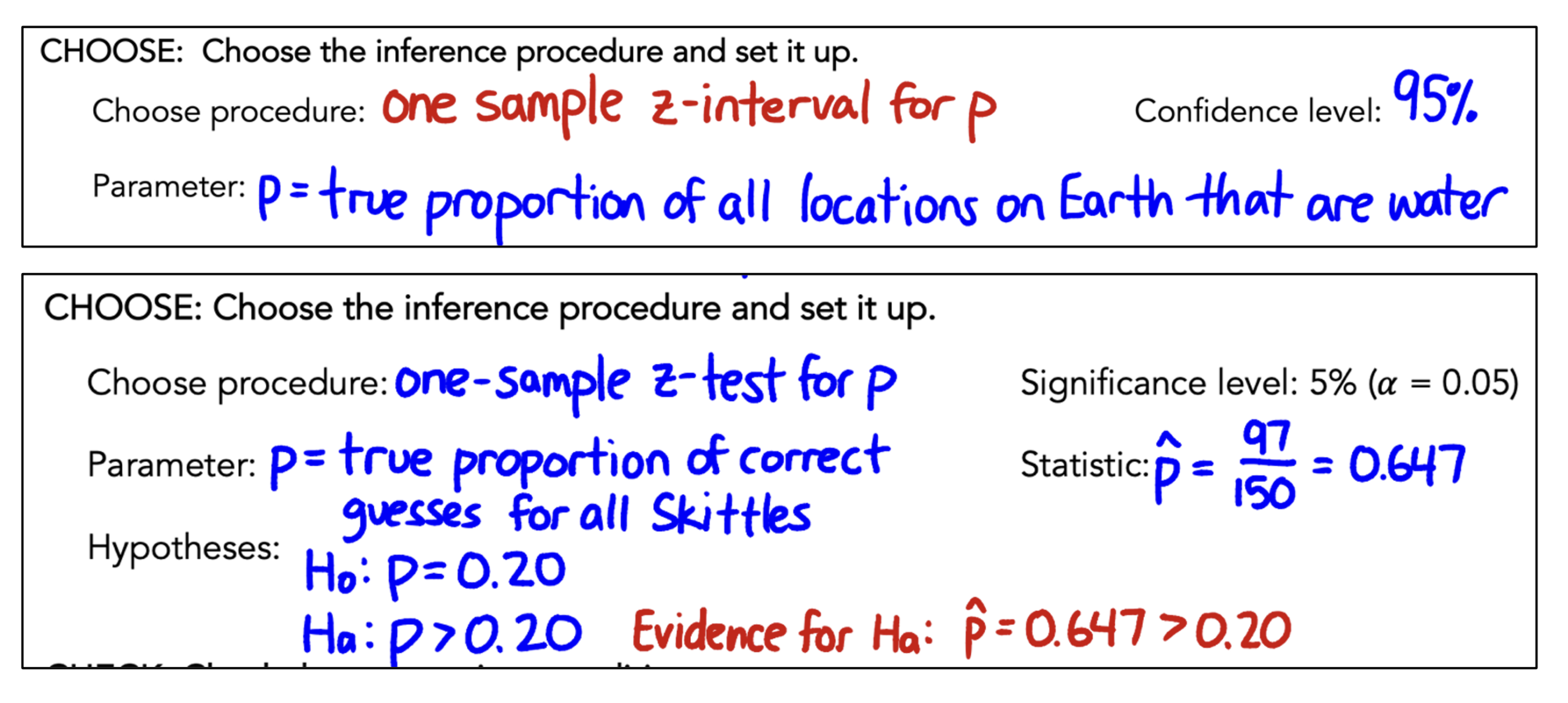
NOTE: This is part (b) of the scaffolded inference question. Here is the rubric:
+1 point
Accurately identifies the appropriate inference procedure.
+1 point
Accurately identifies the null and alternative hypotheses.
+1 point
Accurately identifies the population parameter(s)
CHECK: Check Conditions, Ask “So What?”
Once we have chosen the inference procedure and set it up, it is time to check the conditions to be sure that all of our work will be worth it. While it is important that students know how to check each condition, we think it is equally important that they understand why we check the condition. We call this the “so what” and you will see them in red here.
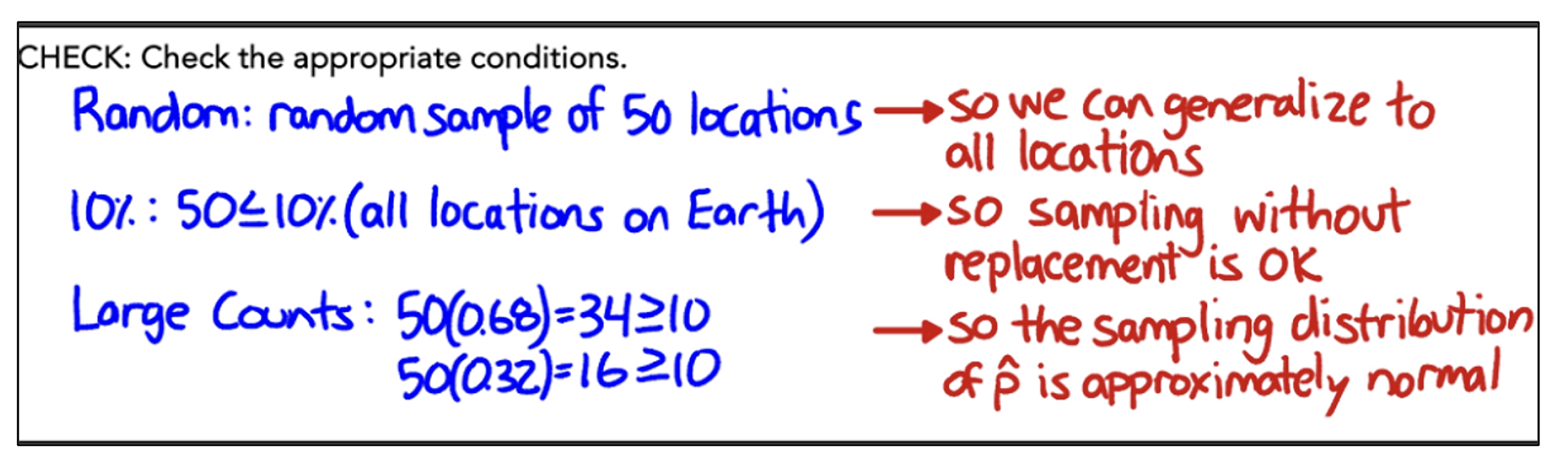
NOTE: The “so what” is NOT required for full credit on the AP Exam rubrics.
+1 point
Accurately justifies whether the randomization condition and 10% condition are met.
+1 point
Accurately justifies whether the normality condition is met.
CALCULATE: Formulas by Thinking, Not Memorizing
Instead of going directly to Desmos, we want our students thinking about what it means to calculate a confidence interval or to calculate a test statistic and P-value. For this reason, we have students write out a general formula first and then build the specific formula that goes with the inference procedure chosen. To finish out, they plug in numbers and come up with an answer.
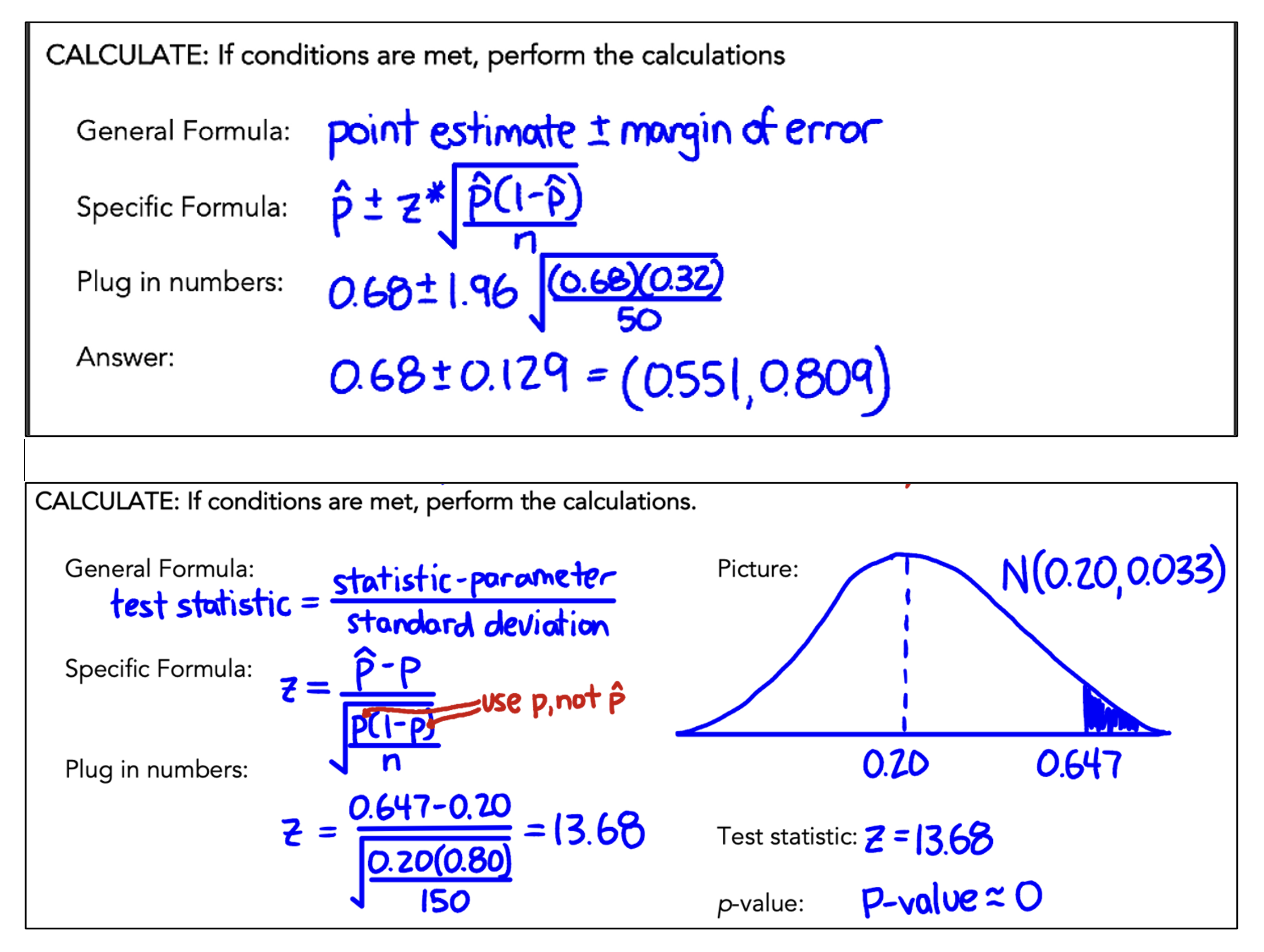
NOTE: The formulas are not required for full credit on the AP Exam. For full credit on a confidence interval, students need only provide the correct interval. For full credit on a hypothesis test, students need only provide the correct test statistic and P-value.
+1 point
Accurately calculates the results for the appropriate statistical inference method.
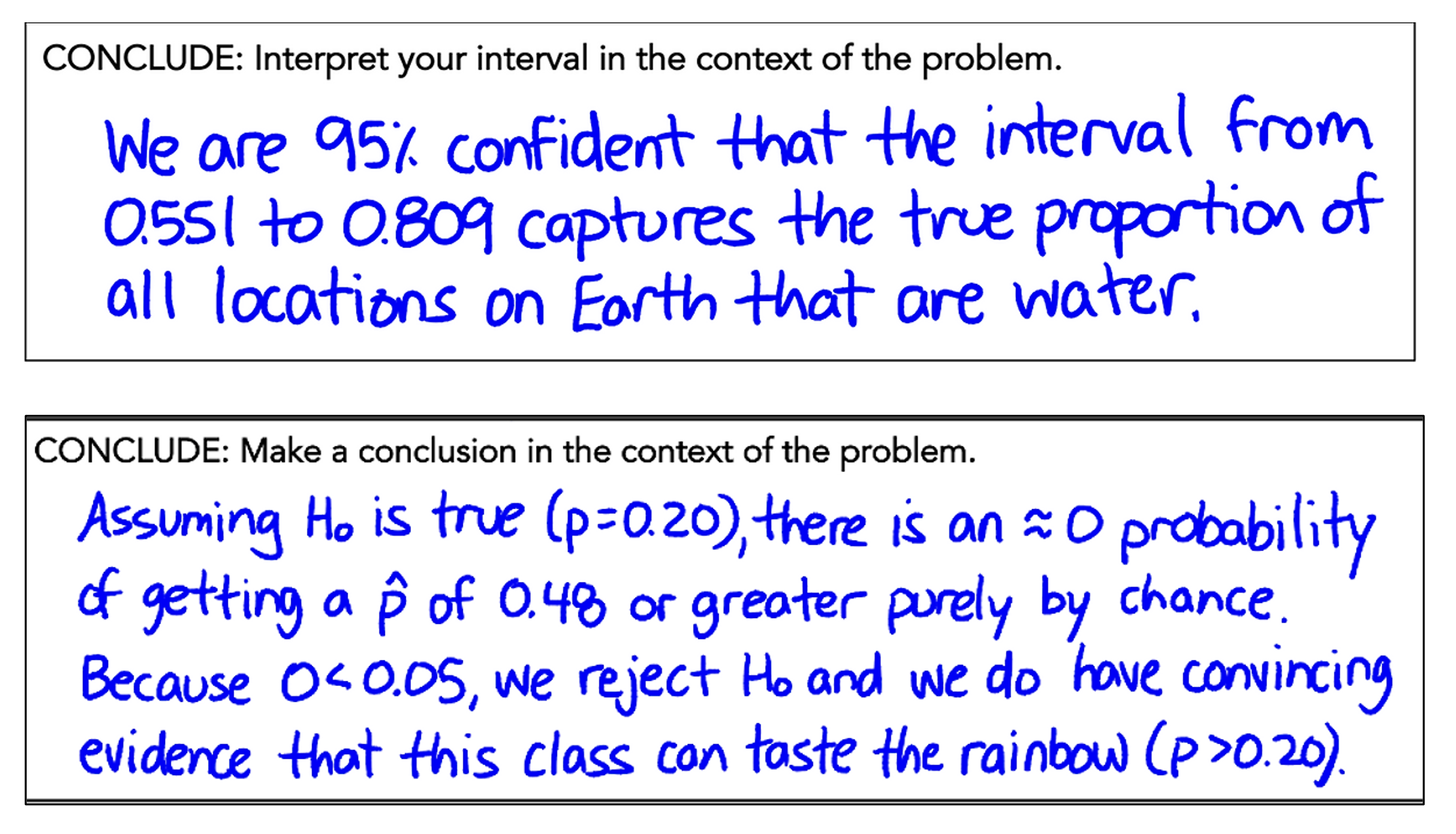
CONCLUDE: Put it in Context
Here students will give a full interpretation of their confidence interval OR give a full conclusion for a hypothesis test.
DOWNLOAD: The 5C Method for Inference Templates
Template for Confidence Intervals