
Why Bother with z-scores and Table A?
Math Medic
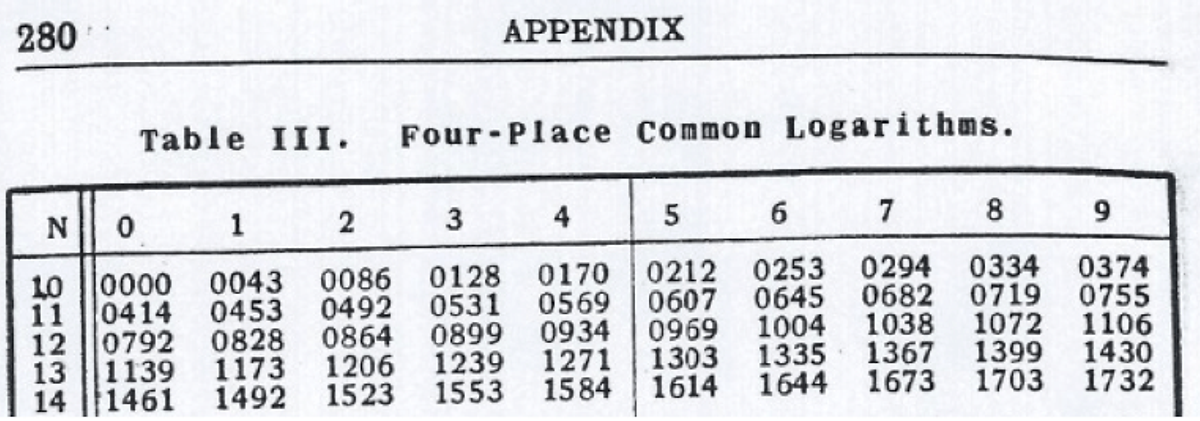
We use z-scores and Table A to help us find area under normal distributions (P-value) so that we can make a conclusion to a significance test. But calculators and technology can do all this work for us. Tables of values are archaic. We most certainly aren’t still using one of these to find logarithms:
So why bother with z-scores and Table A?
The most obvious answer
Besides helping us to get the P-value, z-scores allow us to fairly compare values that come from two different distributions. Kyra is a 4th grader who is 49 inches tall and Kirah is a 6th grader who is 56 inches tall. Who is taller within their age group?
But there is a better reason.
The better answer: Inferential thinking
When experienced statistics thinkers are given a scenario, we usually have some idea about whether or not the results are statistically significant. Let’s look at an example:
The school newspaper took a random sample of 400 students at East Kentwood High School and asked them whether or not they approved of building a new parking lot in front of the school. 59% said that they approve. Does this provide convincing evidence that a majority of students approve the new parking lot?
In my mind, I think “for a majority, we need 50% and this result is 9% above that. Moreover, the sample size of 400 is large enough that the variability in the sampling distribution will be pretty small…so I think the probability of getting 59% purely by chance is very low (P-value), so our result is statistically significant.”
There are three levels of thinking displayed here:
How far is my value away from what was expected?
How many standard deviations is my value away from what was expected? (z-score)
How likely is it to get my value purely by chance (P-value!).
Calculating and understanding z-scores (level 2) is the thinking that connects us to the P-value (the holy grail). If we simply use a calculator or an applet to find the P-value, we have skipped over the inferential thinking. But let’s be careful here. If students are simply calculating the z-score as a memorized process, then their inferential thinking is not being developed. We need to be sure that students are interpreting the z-score (like it’s their job).
In most cases, I will argue for phasing out the old and in with the new technology (see Graphing Calculators are the New Slide Rule), but in this case I stay old school with my students…because ultimately I want them to be able to “feel” statistical significance using their inferential reasoning.