
Mutually Exclusive Events? Ask Turner
Math Medic
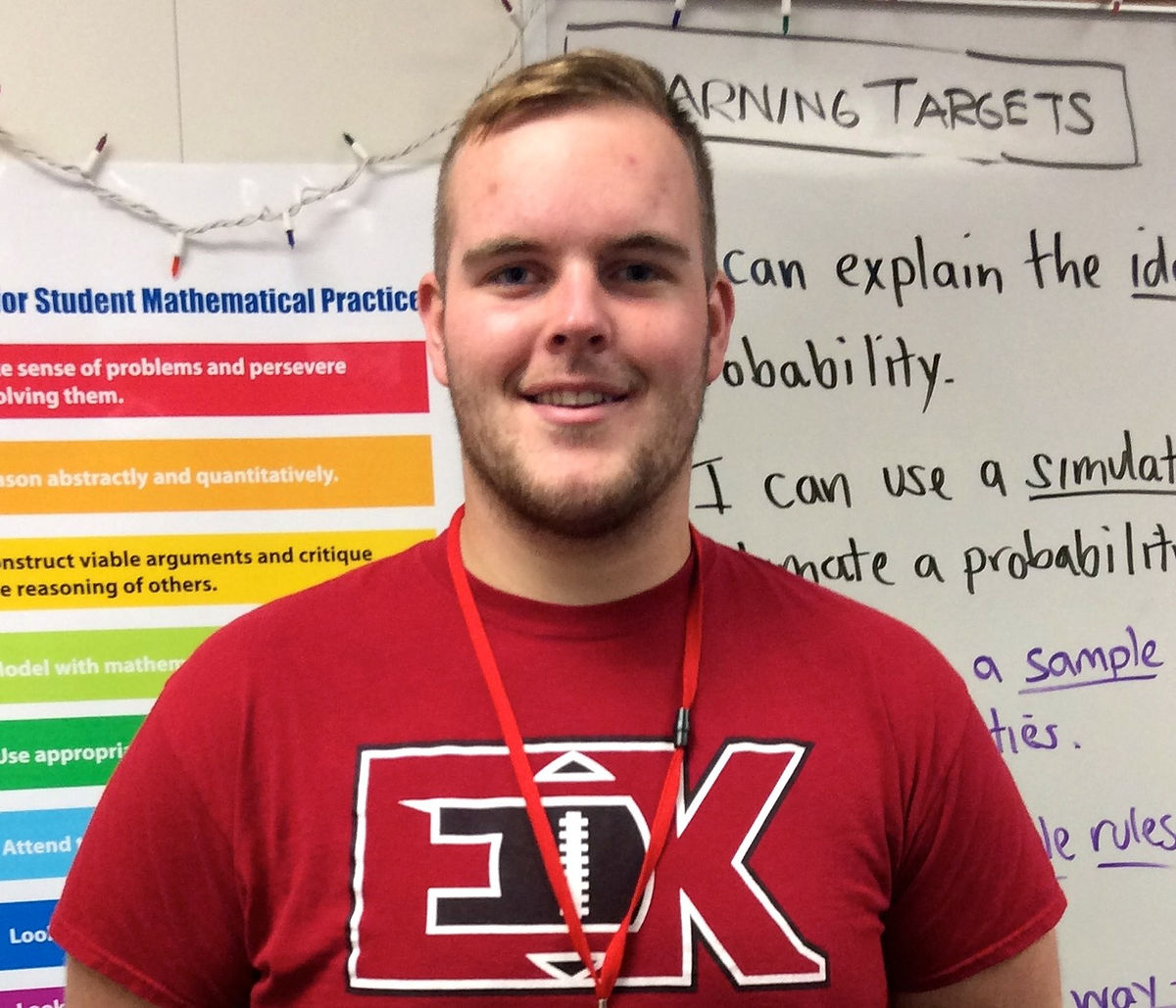
This is Turner. He is in my 3rd hour AP Statistics class. He has blue eyes. He is the reason that students in this class understand the general addition rule for probability.
The general addition rule
Most students have seen the general addition rule during the two weeks of probability in their Algebra 2 class. They memorized the formula, did the 14 problems in the homework, and then got 100% on the test. But did they understand the formula? I find that formulas often hide understanding of probability concepts.

An activity for understanding the formula
I choose ten students to come up to the front of the room and stand in a row. Best case scenario is that you have 5 males and 5 females, and at least 2 that have blue eyes. Most important: Choose only 1 male that has blue eyes (Turner!!).
I tell the class that I am going to randomly choose one of the ten students, and I want to think about some probabilities.
Example #1
-
Event A – the student has blue eyes
-
Event B – the student has brown eyes
-
Find P(A), P(B), and P(A or B)
As a whole class, we start by finding P(A). I ask all students who have blue eyes to step forward and raise their hand up high. I pointedly count the identified students in front of the whole class and then record P(A) on the board.
We then do the same for P(B) and P(A or B) (remember this is the Starbucks “OR”).
After I pointedly count the students that fit into the event (A or B), I make note of the fact that I could have simply added P(A) and P(B).

Example #2
-
Event A – the student has blue eyes
-
Event B – the student is male
-
Find P(A), P(B), and P(A or B)
I approach this example exactly as example 1. For event A, all students with blue eyes step forward and raise their hand. For event B, all male students step forward and raise their hand. When I get to P(A or B) I start by trying to simply add P(A) and P(B). Then I ask students to step forward and raise their hand if they are “blue eyes or male”. Of course, this answer doesn’t match the answer from our formula. To try to resolve the situation, I go back and have students who are in event A raise their hand again, and then students in Event B raise their hand again. The class realizes that Turner has been double counted. To fix our incorrect answer, we have to “subtract out one of the Turners”.
Generalize from the example
We then use our calculation to generalize to the formula:

I ask students when we have to use this formula. Usually I get a response like “when events A and B can both happen”. I ask them to clarify using appropriate vocabulary and we arrive at the proper conclusion “when events are NOT mutually exclusive”.
Ask Turner
For the remainder of the school year, any time I encounter a quiz or test question in which a student has mistakenly forgot to subtract out the overlap in a P(A or B) question, I simply write “Ask Turner”.