
NCTM 2026 Recap – A Love Letter to Mathematical Practice #7
Kelly Pendleton
When I started teaching in 2011, I remember receiving a poster with 8 mathematical practices that I had never seen before. They all seemed good in theory, but I didn’t take them very seriously. I put the poster up on my wall (mostly because it was my first year teaching and I had few other options) and went on with my day.
It wasn’t until I had years of math teaching experience under my belt that I even had time to think more about the mathematical practices. By then, I was more comfortable with my own understanding of math and realized the value of perseverance, precision, and my personal favorite, structure.
Mathematical Practice #7 is the practice of looking for and making use of structure. When I first read that in 2011, I had no idea what it meant. Now, I like to think of it as “the path of least resistance.” What inherent structure of the problem can we use to solve it more efficiently? Ultimately, taking this path of least resistance to problem-solving makes room for conceptual understanding. This is why I decided to write a love letter to Mathematical Practice #7 as my first ever session at NCTM in Denver this year. Let’s dive in!
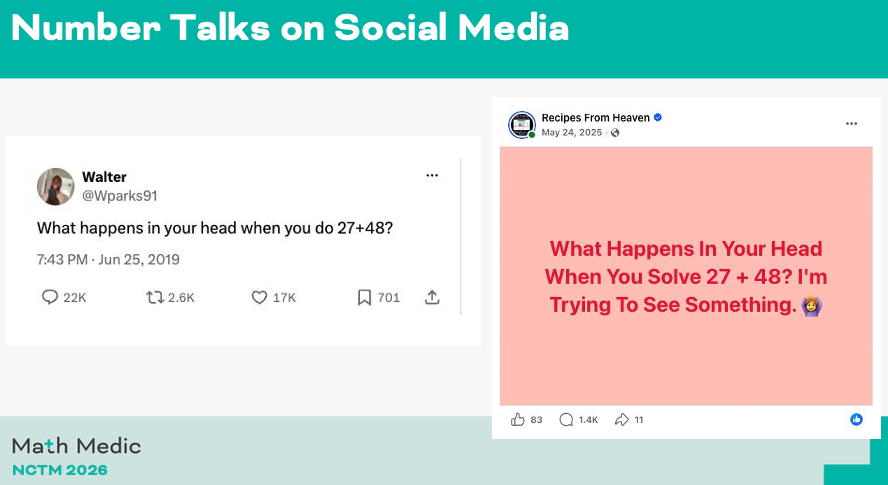
Reading through comments on a social media post can be a dangerous game and one I usually try to avoid. Especially when the question is a simple math expression and the comments reveal that many adults still don’t know the order of operations (both literally and figuratively). However, I was pleasantly surprised when I read through the comments on this post from 2025 (inspired by the original in 2019 with 22,000 comments!). Go ahead and think about it for a few seconds. Did you line them up in your head or use some element of the numbers 27 and 48 to figure it out?
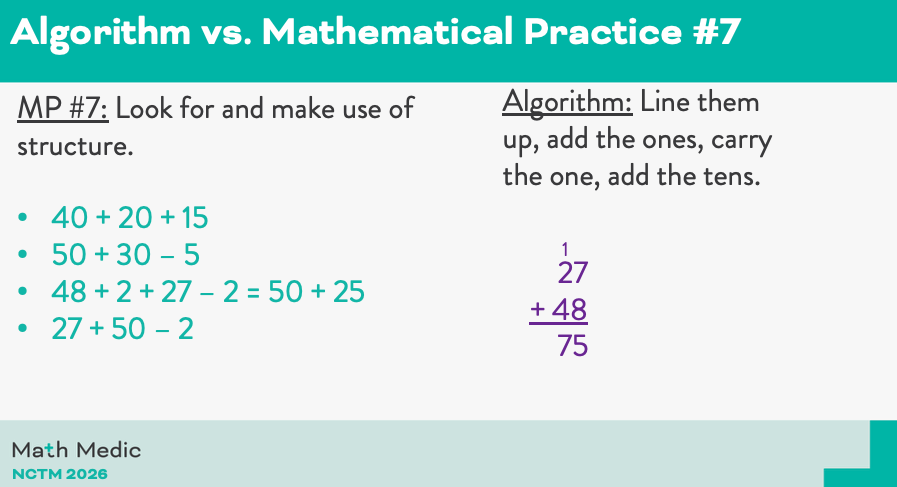
I asked this question to my friends and family as I was preparing for the session and was shocked to hear how many were lining the numbers up in their head and using the algorithm! They had been conditioned from their early years of math to follow the steps no matter what. As they were thinking, I could see them struggling with keeping the numbers straight in their head and carrying the one. In contrast, those who used some structure of the numbers (rounding down then adding the leftovers, rounding up then subtracting the extra, adding 2 to one and subtracting 2 from the other to balance it out, etc.) were more confident, which made them excited to share their strategy.
I followed up with 27+99 and almost everyone used the structure of the numbers to get to 126. If you think about it, lining them up and adding 7+9 would be a wild way to get the answer! So why couldn’t they use a similar thought process for 48? This tells me that the ability to use the structure is there, they just need more opportunities to think that way.
After exploring what it means to look for and make use of structure through the number talks, we moved on to calculating the distance between two points. Check out this student work along with advice on how to help them:
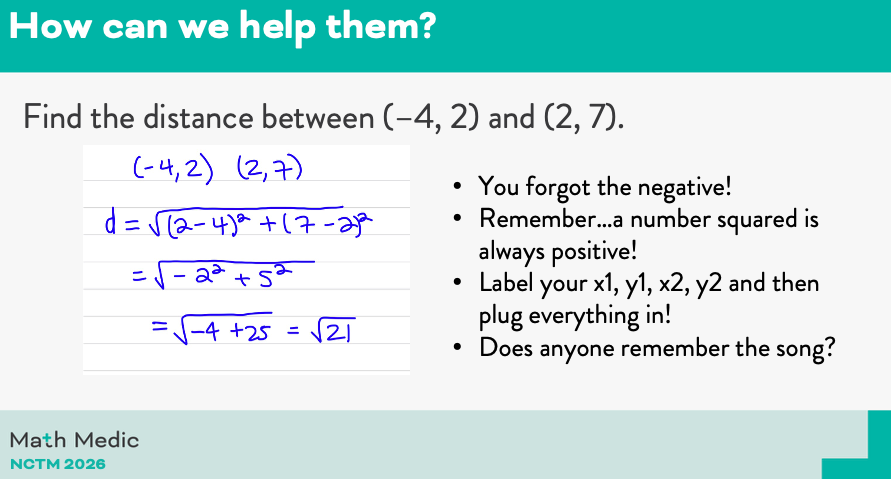
This student is clearly confused. They forgot the negative, left off the parentheses and then kept the negative after squaring. It’s a mess! To help students like this, I used to sing a song to the tune of Yankee Doodle. It went like this:
To find the distance of a line, you draw a long square root sign.
Then x2 minus x1 squared plus y2 minus y1 squared.
Then to find the midpoint, this is what you do:
add the x’s and the y’s and then divide by 2!
It covers both distance and midpoint! What a hit! But it also has absolutely NOTHING to do with what the distance (or midpoint) between two points means. How could using the structure of the distance between two points help them calculate it more efficiently? Enter: Math Medic Geometry Lesson 4.6.
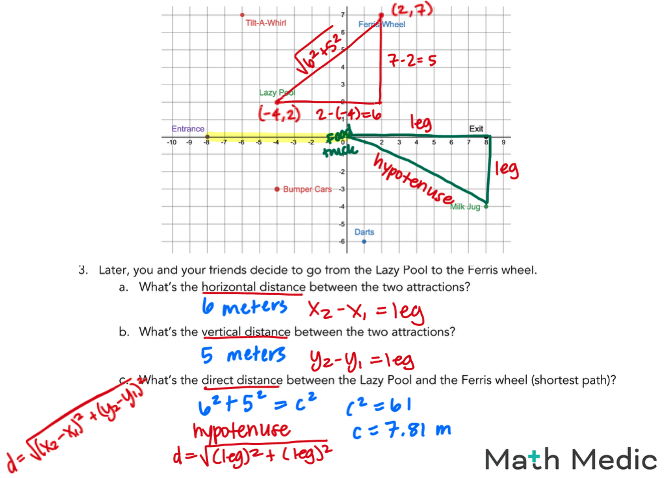
In this lesson, students use the fact that the shortest distance between two points is the hypotenuse of a right triangle. With this structure, students can easily find the length of each leg and then use the Pythagorean theorem to find the distance. Notice the two points are (–4, 2) and (2, 7), which are the same two points our sample student used. This time the answer can be found with much less room for error.
Next, we looked at more student work on a favorite topic for many math teachers, but a frustrating topic to grade on tests: systems of equations.
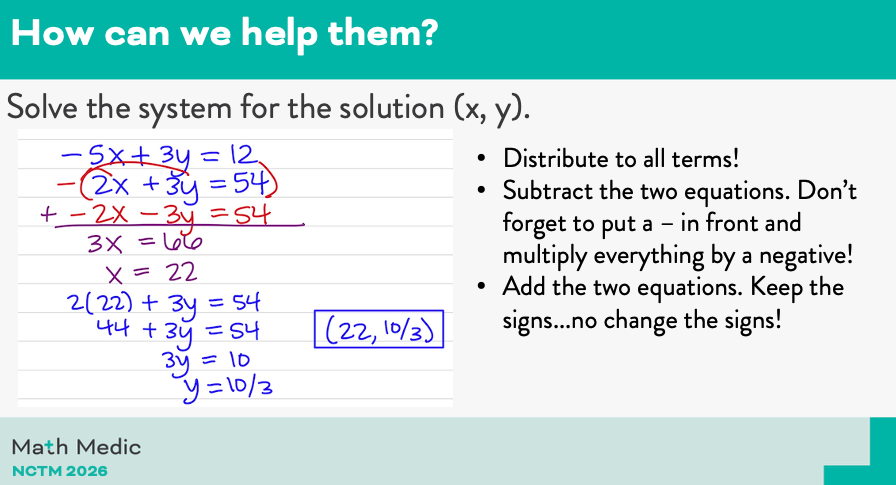
Where did this student go wrong? They’re definitely confused about a few of the steps for solving a system of equations using elimination. How do we even go about giving points for this on a test? What does this student understand about elimination? To be honest, I didn’t understand much better until I started making use of the structure instead of following a set of prescribed steps. Even though I considered elimination my “favorite strategy,” I didn’t fully understand it until going through Math Medic Algebra 1 Lesson 4.4. Here is the opening question:
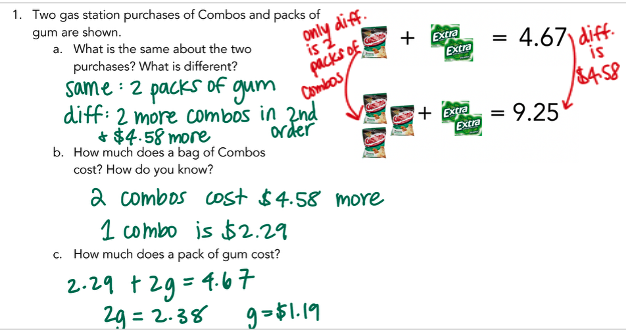
Instead of getting hung up on the steps, it’s more intuitive to think about the change from one purchase to another. The two additional bags of Combos in the second purchase are the reason for the $4.58 price increase. Therefore, we know one bag of Combos costs $2.29.
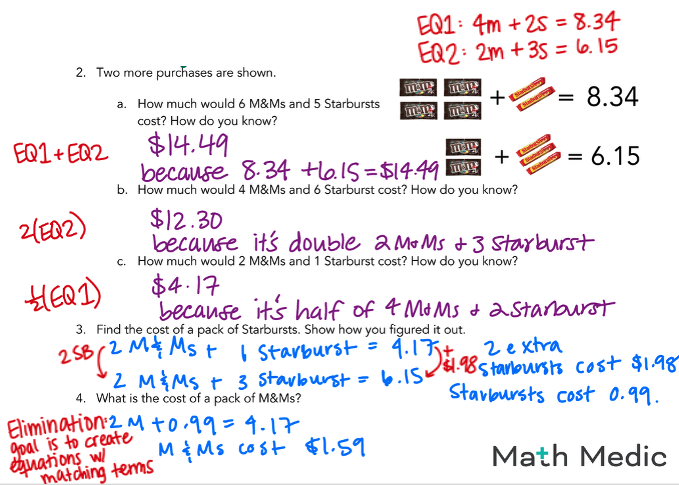
When using the strategy of elimination, the goal is to find or create equations with matching terms so you can “ignore” (or eliminate) what’s the same in both equations and focus on the differences. Check out how a student who has gone through this lesson might solve the same system from before:
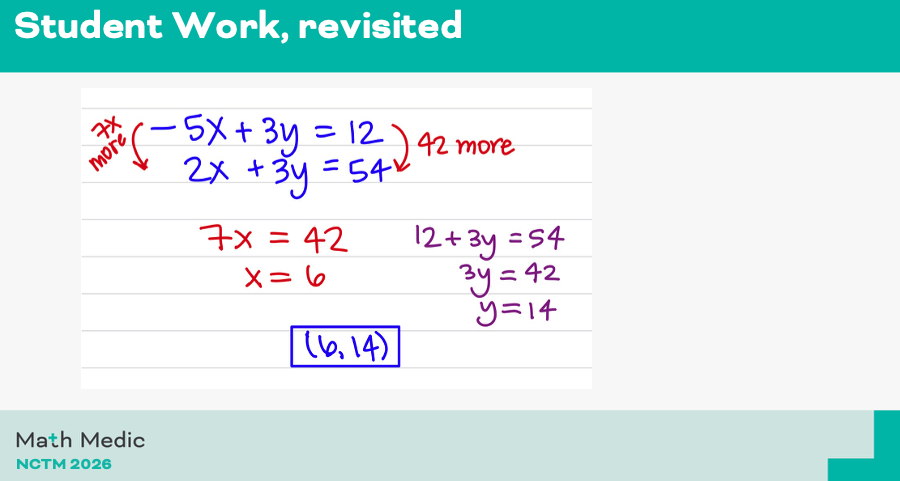
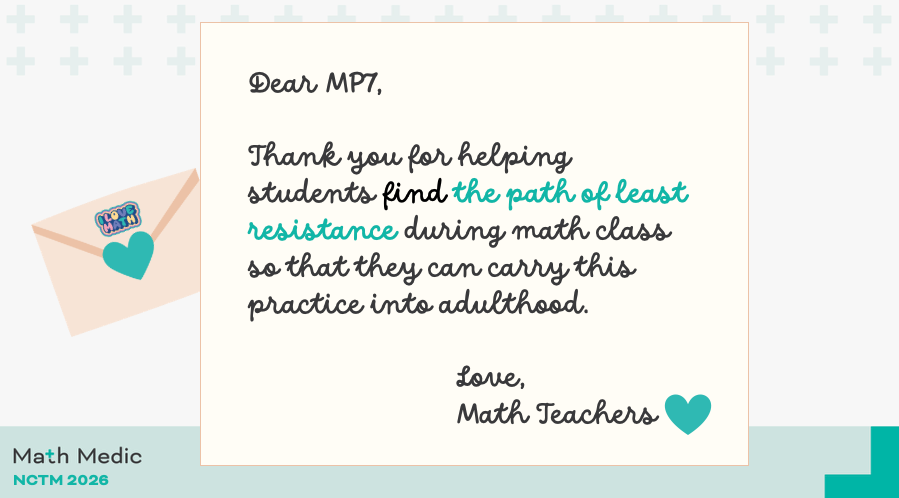
And this is why I ❤️ MP7! It is truly the path of least resistance in problem solving. And as a final nod to my session’s title, I of course had to end with an actual love letter:
I keep thinking back to the look on my friend’s face as she was struggling to add 27 and 48 in her head. As soon as I asked the question, I could see the panic in her eyes. She was stuck with the algorithm. Mathematical Practice #7, making use of the structure of the problem, provides a different path forward. Students (and adults!) feel more ownership over their strategy, which in turn creates deeper understanding and overall comfort with math.
About the Author

Kelly Pendleton
Kelly was a high school math teacher for over 10 years in Charlotte, NC before joining the Math Medic team full time. At Math Medic, she is a member of the content team and is responsible for all statistics-related content. You’ll also find her writing weekly newsletters, leading workshops, and working to improve teachers’ experience in the assessment platform. Kelly is passionate about schools having equal access to quality materials no matter where they’re located and loves that Math Medic is helping to better that.